- The Recruiting Life
- Posts
- They’re Already Here — The AI Agents Hiding on Your Org Chart
They’re Already Here — The AI Agents Hiding on Your Org Chart
What changes when AI stops being “software?”

Jim Stroud
January 11, 2026

The Recruiting Life is brought to you by: ProvenBase

The Recruiting Life Newsletter
I tried to write this as a single piece.
I couldn’t.
Every time I followed the thread—AI on org charts, performance metrics, labor law, accounting rules—it opened another door. And behind each door was a harder question than the last.
So I stopped pretending this was “just an article” and turned it into a 4-part series.
Part 1 asks the question most companies aren’t ready for yet:
What happens when AI stops being a tool and starts behaving like a workforce member?
Not hypothetically.
Not “someday.”
Right now.
We’re already seeing AI agents assigned roles. Measured. Compared. In some cases, trusted more than people. And once that’s true, everything changes—how work is structured, how performance is judged, and how careers are decided.
This first piece sets the stage. It doesn’t solve the problem. It shows you why the problem exists at all.
If you’ve felt a vague unease about where AI is headed at work—but couldn’t quite name it—this will put language to it.
👉 Read Part 1: They’re Already Here: The AI Agents Hiding on Your Org Chart
Part 2 goes where most commentary won’t: the performance data.
Parts 3 and 4 deal with the consequences.
Fair warning: once you see it, you can’t unsee it.
The more you read, the more your anxiety will increase.
Get started.👇

Most recruiting systems reward visibility.
ProvenBase rewards proof.
If your team keeps revisiting the same candidates while roles stay open, the issue isn’t talent availability.
It’s how the market is being searched.
ProvenBase uses Deep Search to surface candidates based on demonstrated skills, real-world context, and intent—not who markets themselves best or happens to sit in the usual databases.
The result: broader pipelines, less noise, and faster access to people who can actually do the work.
This isn’t another sourcing tool.
It’s a different view of the talent market.
👉 See how it works: provenbase.com
The HR Blotter
What People Say After You Lay Them Off Matters More Than What You Promise Before - Layoffs are no longer a private HR event. They are a public performance, and the people leaving control the microphone. How you handle exits now determines what candidates, customers, and remaining employees believe about you long after the org chart changes.
Digital Skills Are Quietly Rewriting Women’s Paychecks - Digital literacy is not a nice to have for women at work, it is the difference between earning more and getting squeezed by flexibility that never pays. Women with real digital skill gain wages, confidence, and access to better opportunities, while those without it absorb more work and less money. In the modern labor market, digital literacy decides who moves up and who just works longer hours in the dark.
Dragged Back to the Office, Nowhere to Sit - AT&T dragged workers back to the office to prove culture and productivity still live under fluorescent lights, then discovered the building could not hold the bodies it demanded. (Whoops!) Now the company is spending years and acres rebuilding a headquarters to justify a policy that quietly treats visibility as loyalty and inconvenience as leverage. In the world of work, this is what happens when control moves faster than trust and bricks get blamed for a people problem.
When the Jobs Numbers Break Before the Jobs Do - The White House is scrambling after President Trump appeared to leak embargoed jobs data before the official employment report, raising alarms about trust in the numbers that guide markets and workforce decisions. When economic data slips early, it does not just move stocks, it rattles employers, workers, and policymakers who depend on clean signals to plan hiring and layoffs. In the world of work, credibility is infrastructure, and once it cracks, everyone feels the tremor.
The Economy Grows, Paychecks Shrink - Labor’s cut of the US economy has sunk to the lowest level since records began in 1947, even as productivity jumps and profits swell. Workers are producing more, partly thanks to AI, but a smaller share of the value is landing in their paychecks. In the world of work, this is the tell: efficiency is rising, power is shifting, and wages are no longer keeping pace with what labor creates.
The Best Candidates Don’t Show Up in Your Searches - Most recruiting pipelines are thin not because talent is scarce, but because sourcing tools only see who is loud, visible, and self-promoted. The people actually doing the work are publishing, building, and contributing in places recruiters never search. That blind spot is why so many critical roles stay open.
…
The Jim Stroud Podcast
Not subscribed to The Jim Stroud Podcast? Then you’ve been flying blind. Here’s a sneak peek at the latest episode debuting tomorrow.
…
A Smarter Way to Support Employees You’re Letting Go
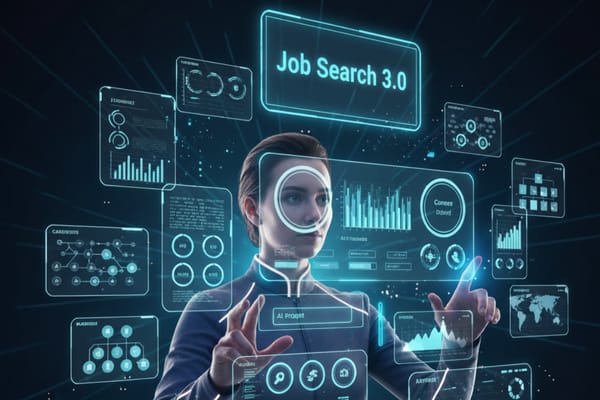
Layoffs end employment. They don’t end reputation.
Most laid-off employees are sent back into a job market that no longer works the way they were taught. Job Search 3.0 is an 11-module, AI-powered program companies use to help exiting employees attract opportunities that never hit job boards. It teaches modern visibility, recruiter discovery, and job-search strategy—without false promises or generic advice.
For employers, it’s a practical, scalable way to support transitions and protect employer brand when it matters most.
👉 Learn more about Job Search 3.0
…
They’re Already Here — The AI Agents Hiding on Your Org Chart

The Org Chart Moment Everyone Missed
Picture this.
A Fortune 500 org chart leaks on a random Tuesday morning. Not earnings. Not layoffs. An org chart.
Under the VP of Talent Acquisition sits a role that didn’t exist last quarter:
AI Recruiting Agent — Level 3
It has KPIs.
It has a reporting line.
It even has a promotion path to Level 4.
HR Twitter spirals. LinkedIn fills with “thoughtful takes.” The usual mix of jokes, fear, and denial follows.
But here’s the part that matters:
Nothing about this is hypothetical.
While most HR teams are still debating whether it’s “safe” to use ChatGPT for job descriptions, a quieter shift has already happened. Some companies aren’t just using AI anymore. They are formally recognizing AI agents as workforce entities—with roles, performance metrics, and accountability frameworks. You can already see early versions of this in recruiting, where systems like ProvenBase operate less like search tools and more like always-on agents scanning for real-world work signals.
Not tools.
Not experiments.
Organizational actors.
That distinction changes everything.
This isn’t a productivity story. It’s a workforce story.
Once AI outputs start being treated like employee actions, you trigger second-order consequences—legal, financial, and operational. We’re already seeing that play out:
Legal frameworks beginning to treat AI output as organizational responsibility
Accounting debates over whether AI is software, an asset, or something closer to labor
Labor unions forcing guardrails around AI use in newsrooms
And the adoption curve is already steep:
25% of enterprises were testing agentic AI by the end of 2025
50% adoption projected by 2027
So the real question isn’t whether AI is entering your organization.
It’s whether it already has—without being labeled as such.
Frontier Firms and the Quiet Redesign of Work
Microsoft quietly introduced a term in its 2025 Work Trend Index that didn’t get nearly enough attention: the Frontier Firm.
These aren’t companies that “use AI.”
They are companies designed around human-AI collaboration from the start.
Buried inside that framework is a critical shift: agent-led work.
Humans set direction.
AI agents execute workflows.
Entire functions begin to operate this way.
SAGlobal breaks Frontier Firms into five operating pillars. Read them closely—this is where org design quietly breaks from tradition:
The Agent Boss
Not a technical role. A management one.
Someone whose job is to direct, govern, and evaluate AI agents the same way they once managed people.Digital Labor
Execution capacity that scales instantly.
No hiring cycle. No onboarding lag. No contractor negotiations.
Just capability—on demand.The Hybrid Worker
The modern knowledge worker now operates with AI in-line.
Strategy on one side. Continuous machine augmentation on the other.
This is already normal inside high-performing teams.Intelligence Resources
HR and IT blur together.
Recruiting isn’t just for people anymore.
Someone has to onboard, evaluate, and govern agents too.Autonomous Agents
Systems that don’t wait for instructions.
They operate inside guardrails, escalate when needed, and improve based on outcomes.
And then there’s the metric that should stop every HR leader cold:
The human-agent ratio.
That’s not a thought experiment. It’s already being discussed as a measure of scale and efficiency.
Translation: Your value may soon be judged less by what you do—and more by how many AI agents you can effectively manage.
“Treat AI Like a New Hire” — And Mean It
If this still sounds theoretical, consider how some companies are already operating.
Prem Kumar, CEO of Humanly, doesn’t talk about AI as a tool. He talks about it as labor.
His guidance to customers is blunt:
“Treat AI like any new hire—write a job description, define the role, and interview it before bringing it on board.”
This isn’t metaphor. It’s process.
Define the problem.
Define the responsibilities.
Evaluate fit.
That mindset forces organizations to stop pretending AI is plug-and-play. It also raises an uncomfortable question no one wants to answer directly:
If you recruit it, define its scope, evaluate its output, and rely on its performance—
how is it functionally different from an employee?
We’re already seeing this tension play out in the real world.
At POLITICO and E&E News, 260 journalists now work alongside AI agents—a fact surfaced during a labor arbitration case.
Zoom out, and the numbers get harder to ignore:
92% of HR leaders already use AI for screening and scheduling
30% of organizations expect “digital workers” to be core contributors by 2025
The line between tool and teammate is no longer clear—and pretending otherwise is a liability.
When Accounting Runs Out of Language
This is where the abstraction ends.
Because eventually, everything hits the balance sheet.
Right now, AI development costs are treated like software—capitalized, amortized, or expensed under existing rules like ASC 350-40.
But even Deloitte is signaling that this framework is breaking down.
Why?
Because AI agents don’t behave like static software.
They learn.
They adapt.
They generate future economic value without direct human execution.
So what are they?
Software?
Intangible assets?
Or something closer to digital employees?
This isn’t academic. It affects valuation, ROI calculations, and workforce planning.
PwC already documents AI agents autonomously performing reconciliations, variance analysis, and transaction matching—while remaining audit-ready.
Nominal.so shows this in practice: AI agents operating across ERP systems, generating narrative explanations, and linking financial data to CRM activity.
All of this is arriving just as 75% of CPAs are expected to retire over the next 15 years.
AI isn’t just filling gaps. It’s redefining the category.
So here’s the unresolved question finance and HR now share:
If an AI agent depreciates like an asset but performs like labor—
what is it, exactly?
And who carries the accountability?
The Shift, Quantified
This isn’t slow. That’s the real story.
Adoption
Leadership
39% of large enterprises have appointed a Chief AI Officer (CAIO) or equivalent in 2026, up from 33% in 2025
52% of AI/data leaders believe a dedicated CAIO role should exist, with 90% of firms now featuring some Chief Data/AI Officer variant.
Managerial Reality
Managers are already using AI to make career-defining decisions:
Read that again.
AI is already shaping human careers—while quietly competing for the same organizational trust and resources.
The Metric You’re Not Ready For
Once AI agents sit on the org chart, comparison becomes inevitable.
And once performance is compared side-by-side, the conversation stops being philosophical.
In Part 2, we’ll look at real performance data comparing human recruiters to AI agents.
Here’s the preview:
Time-to-Fill: 7–10 days (AI) vs. 30–50 days (human)
Outreach Response Rates: 20–25% vs. 8–12%
Cost & ROI: 50–80% cost reduction, 10x–20x ROI per hire
(yikes!)
So before you read part 2, ask yourself this:
If an AI agent outperforms you on every measurable dimension—
what’s the argument for keeping you?
Next week: “The Performance Review That Ends Your Career.”
(If you’re nervous about reading it, imagine the anxiety I feel writing it.)
…
The Comics Section

…
One more thing before I go…

I look forward to attending the Evolve Conference later this month. See you there.
Okay, 2 things…
If recruiting is your game, you’ll want The Recruiting Radar on your radar. Monthly intel on who’s about to hire—and what’s driving it. January reports are free, no strings attached, just a preview of what’s coming next.
…
And as always, hit reply and let me know how I’m doing. Or slide into my DMs as the kids say. All good.
…

Reply