- The Recruiting Life
- Posts
- The Recruiting AI Arms Race: You're Funding Both Sides of a War You Didn't Start
The Recruiting AI Arms Race: You're Funding Both Sides of a War You Didn't Start
Yikes! Candidates and employers use competing algorithms that cancel each other out but prosper SAAS vendors.

Jim Stroud
April 12, 2026

The Recruiting Life Newsletter
the skinny
AI is now on both sides of the hiring table.
Candidates are using it to write polished, keyword-perfect resumes in seconds.
Employers are using it to filter, rank, and reject those same resumes just as fast.
On paper, this should make hiring more efficient.
In reality, it’s created a strange kind of stalemate—more applications, less signal, and a growing sense that the system isn’t actually surfacing the best people.
Even more concerning: many hiring decisions are now being made (or heavily influenced) by systems that aren’t especially good at what they claim to do.
So we end up here:
Better tools. Faster processes. Worse outcomes.
The uncomfortable question isn’t whether to use AI in hiring.
It’s whether we’ve quietly built a system that optimizes for the appearance of quality instead of the real thing.
If you’re hiring—or job hunting—this is worth a deeper look.
Read. 👇
Sponsored by ProvenBase
Your “great hire” isn’t a bargain. It’s a countdown.
They accepted less.
But they didn’t lower their value.
And when the market shifts… they’ll leave.
Most hiring teams keep fishing in the same crowded pool
where compensation is the only lever.
ProvenBase shows you a different market.
Hidden talent isn’t cheaper.
It’s just not being bid up.
Fewer competing offers.
Better alignment.
Stronger long-term hires.
The Recruiting AI Arms Race: You're Funding Both Sides of a War You Didn't Start

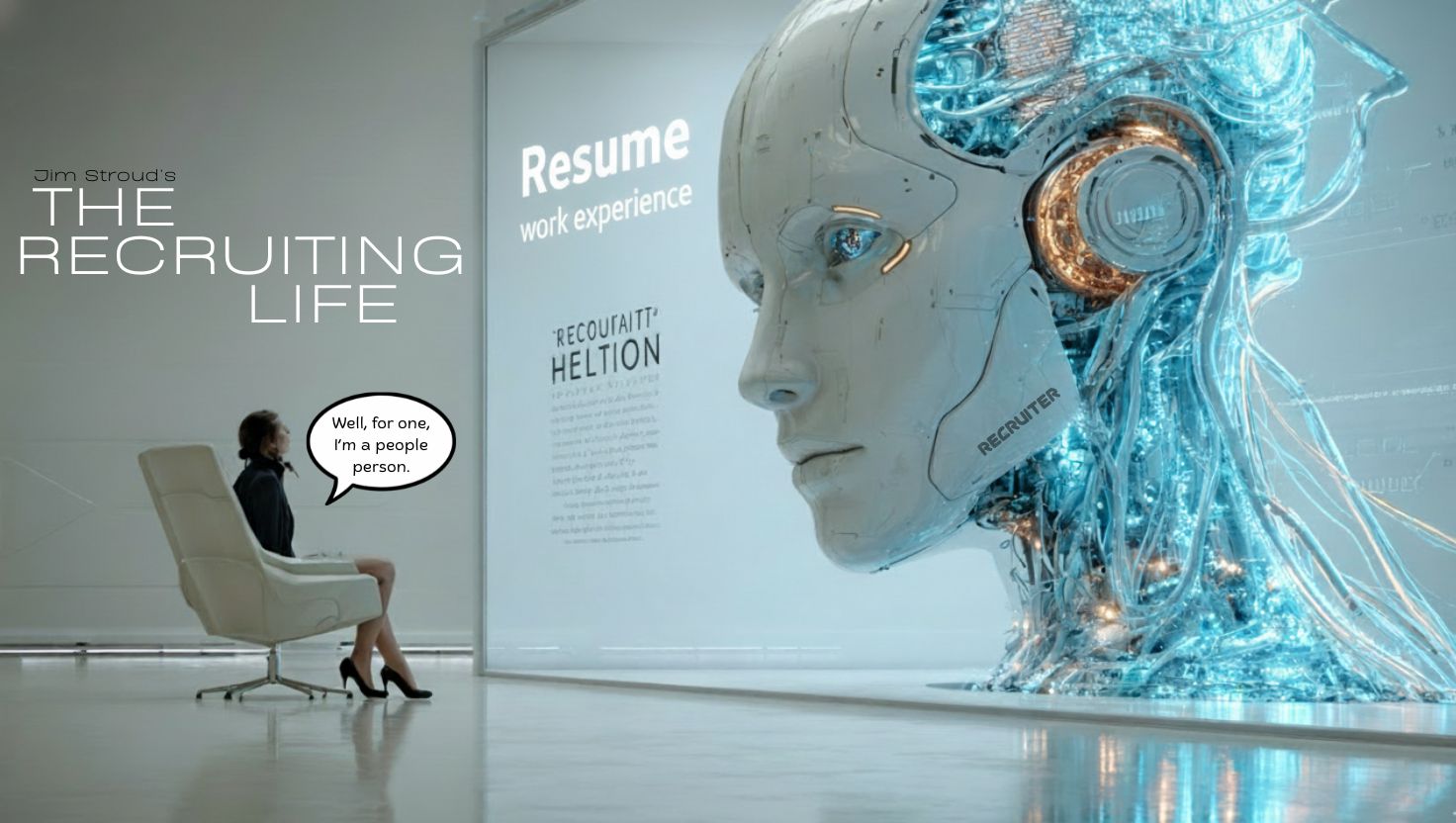
79% of candidates now use AI to apply for jobs. 66% of hiring managers use AI to screen them out. Both sides are paying $30 a month to cancel each other out. The only winners? The SaaS vendors.
Somewhere right now, a candidate is pasting your job description into ChatGPT and getting back a perfectly tailored resume in 45 seconds. At the same time, your ATS is running that same resume through an AI filter designed to detect whether it was written by, you guessed it, AI.
Welcome to the most expensive stalemate in the history of hiring.
The Numbers Are Absurd
According to Resume.org's August 2025 survey of nearly 1,400 full-time U.S. workers, 79% of companies that use AI in hiring deploy it for resume reviews, while 66% use it for candidate assessments. On the other side of the table, roughly 70% of U.S. adults have used AI when applying for a job in the past 24 months, per a January 2026 Statista+ survey, with that figure spiking to 79% among millennials.
Huntr’s Q2 2025 Job Search Trends report pushed the number even higher. Over 90% of job seekers now use tools like ChatGPT somewhere in their application process.
Meanwhile, 88% of hiring managers claim they can spot AI generated applications, according to Insight Global’s 2025 AI in Hiring report. But here’s the thing. When ResumeBuilder actually tested hiring managers’ detection accuracy instead of just asking if they thought they could tell, the results were brutal. Actual detection rates averaged just 52 to 58%.
Let that sink in. Hiring managers are basically flipping a coin.
How We Got Here
The feedback loop is vicious and self reinforcing.
Companies deployed ATS systems to handle overwhelming application volumes. Today, 99% of Fortune 500 companies use automated screening that rejects roughly 75% of resumes before a human ever sees them.
Candidates responded with AI resume builders that optimize specifically for those ATS filters. Makes sense. If a machine is reading your resume, you should probably let a machine write it.
Employers responded with AI detection tools, spending money to figure out which AI optimized resumes were written by AI. Which is most of them.
Candidates responded to the detection by using more sophisticated AI that is harder to detect. And so on.
According to SmartRecruiters data analyzed by SAP SuccessFactors, the average number of applicants per early career job opening has doubled since 2021. This is not just a tight labor market story. This is an AI powered volume explosion.
The Absurd Economics
Here is what nobody talks about. The cost of this arms race.
Candidates are spending $20 to $30 per month on AI resume tools, application auto fillers, and interview prep bots. Employers are spending thousands per month on AI screening, detection, and ranking systems. Both sides are investing aggressively in technology designed to neutralize the other side’s technology.
The net result is alarming. Resume.org found that 35% of companies reject candidates based on AI recommendations at any stage, yet only 26% require human oversight for every rejection. That means AI is eliminating candidates, including great ones, at scale, without anyone checking the work.
Research shows that 88% of employers believe their AI systems screen out highly qualified candidates because of formatting issues or missing keywords. The arms race is not just expensive. It is actively burying the talent you are trying to find.
The Real Losers
Candidates lose. The most qualified person in your applicant pool might have written their own resume, no AI polish, no keyword optimization, and gotten filtered out in seconds. Meanwhile, a mediocre candidate with a $29 per month AI subscription sailed through to the interview.
Recruiters lose. You’re drowning in higher volumes of lower signal applications. The very tools you bought to save time are generating the noise that eats your time.
Companies lose. SAP’s Future of Work Research Lab found that 36–38% of candidates would consider using AI to fake references and work samples, and 51% would consider sending an AI avatar to complete a job interview on their behalf. The trust infrastructure of hiring is collapsing, and the response has been to add more automation.
The only guaranteed winners are the AI tooling vendors on both sides of the table. They have built the perfect market. Sell the disease and the cure to two different buyers.
The Way Out Is Not More AI (It’s Better Signal)
The University of Chicago’s Polsky Center nailed it: “It has never been easier to apply for jobs and it has never been harder to find the right candidate.”
The solution is not to build a better AI filter. The solution is to stop playing the game entirely.
Here is what smart companies are doing.
Kill the keyword dependency. If your screening still relies on keyword matching, you are running a 2019 process in a 2026 world. AI written resumes are optimized for exactly this. Move to skills based assessments that test what people can actually do.
Shrink the top of the funnel. Instead of accepting thousands of applications and trying to filter with AI, create application processes that require a small amount of actual effort. A short video response. A brief skills exercise. A specific problem to solve. The volume drops and the signal quality improves.
Get humans back in the loop earlier. 93% of hiring managers say human involvement is critical. Yet most hiring processes do not involve a human until round two or three. By then, AI has already made the real decisions.
Stop punishing candidates for doing what you do. Here’s the stat that should be tattooed on every hiring manager’s forehead: 99% of hiring managers use AI in the hiring process, but 54% say they’d penalize a candidate for doing the same thing. That’s not a policy. That’s cognitive dissonance.
The Bottom Line
The AI recruiting arms race has one inevitable conclusion if left unchecked. An AI applies to a job. An ATS screens the application. An AI schedules the interview. An AI evaluates the interview.
And somewhere, someone is pitching that as efficiency.
The companies that win the talent war will not be the ones with the best AI filters. They will be the ones who figure out that when everyone’s resume looks perfect, the resume stops being the signal.
The question is not whether to use AI in hiring.
It is whether you are adding more noise or finally cutting through it.
The HR Blotter
The Hidden Workforce Powering Humanoid AI - Filming everyday chores is becoming a new global gig, supplying the massive “human data” needed to train humanoid robots. Startups are hiring thousands to record first-person tasks, but even hundreds of thousands of hours fall far short of the billions required. This data could unlock general-purpose robots, yet safety, reliability, and real-world complexity remain the final hurdle.
The New Software Engineer: Less Coding, More Thinking - AI isn’t killing software engineering jobs—it’s reshaping them, shifting developers away from routine coding toward oversight, design, and problem-solving. Demand for engineers is still rising as AI expands what companies can build, even as layoffs and anxiety create a messy transition. The winners will be those who adapt fast, master AI tools, and evolve with the role.
Software Jobs Surge as AI Fuels Hiring Boom - Software engineering job openings are surging in 2026, with listings up roughly 30% this year and doubling since 2023 lows, undercutting fears that AI is replacing developers. The rebound is driven by renewed tech investment—especially in AI—which is actually increasing demand for engineers. The real pressure point isn’t disappearing jobs, but intensified competition, particularly for entry-level roles.
The Real Hiring Crisis Is Invisible Talent - The traditional college-to-career pipeline is fracturing as enrollment declines and alternative pathways rise, making talent harder to identify rather than harder to find. Employers face a growing skills gap while shifting toward skills-based hiring, valuing real-world output over degrees. The advantage will go to organizations that spot and engage this “invisible” talent early, before it enters the crowded market.
AI Layoffs Are Rising—But Still Nowhere Near Doomsday - Despite loud predictions of AI-driven job collapse, CFOs expect only about 0.4% of jobs to be cut this year—even after a sharp increase in AI-related layoffs. The bigger story is a gap between hype and reality, with AI’s productivity gains lagging behind expectations in a pattern similar to past tech revolutions. AI is reshaping work, but its economic impact is slower, smaller, and more uneven than the headlines suggest.
…
The Jim Stroud Podcast
Not subscribed to The Jim Stroud Podcast? Then you’ve been flying blind. Here’s a sneak peek at the latest episode debuting tomorrow.
…
The Comics Section

…
One more thing before I go…
Sign up for my webinars
Job Hunting is a Team Sport - Landing the right job isn’t just about sending out applications—it’s about leveraging the right network, resources, and support along the way. In this webinar, Job Hunting is a Team Sport, Jim Stroud shares how collaboration, community, and strategy can make your job search more effective and less overwhelming.
Date/Time:
Saturday, April 18, 2026 at 1:00 pm EST
Saturday, April 25, 2026 at 1:00 pm EST
https://webinar.jimstroud.com
…

Reply