- The Recruiting Life
- Posts
- The Performance Review that Ends Your Career
The Performance Review that Ends Your Career
When the new “recruiter” on your org chart never sleeps—and still beats you on every KPI

Jim Stroud
January 18, 2026

The Recruiting Life is brought to you by: ProvenBase

The Recruiting Life Newsletter
It starts innocently: a “pilot,” a new dashboard, an AI recruiting agent added to the process. Then it shows up on the org chart—right beside you—with goals, metrics, and a direct line to leadership. And once that happens, the comparison becomes unavoidable: speed, reply rates, cost-per-hire, conversion… stacked side-by-side in numbers that feel less like data and more like a verdict.
But this isn’t just a story about efficiency or “doing more with less.” It’s about what happens to your career when performance is measured against something that works 24/7, improves automatically, and never needs a reset. And just when you think the headline is displacement, the article pivots to a far more dangerous question—one that could make every HR leader rethink what it means to “deploy” AI inside a hiring function.
Oohh…
This is a good one.
Or a bad one.
You decide.
Get started.👇

Most recruiting systems reward visibility.
ProvenBase rewards proof.
If your team keeps revisiting the same candidates while roles stay open, the issue isn’t talent availability.
It’s how the market is being searched.
ProvenBase uses Deep Search to surface candidates based on demonstrated skills, real-world context, and intent—not who markets themselves best or happens to sit in the usual databases.
The result: broader pipelines, less noise, and faster access to people who can actually do the work.
This isn’t another sourcing tool.
It’s a different view of the talent market.
👉 See how it works: provenbase.com
The HR Blotter
50,000 Jobs and a Shrug: Businesses Hit Pause as Uncertainty Spreads - December hiring barely moved—50,000 jobs added—capping a weak 2025 for job seekers even as unemployment dipped to 4.4% and layoffs stayed low. Employers look spooked by tariff whiplash, stubborn inflation, and AI disruption, while revisions show October was worse than first reported and gains are clustering in health care and hospitality. The Fed now faces a nagging paradox: growth is solid, but hiring is stuck in “low-hire, low-fire” mode—stable, yet frustrating.
From Workslop to Doppelgangers: Why CHROs Can’t “Business as Usual” This Year - Gartner says CHROs are inheriting a bigger job in 2026: design the human-machine workplace while CEOs chase AI-fueled growth and a “new deal” with employees. The nine trends read like a warning label—RIFs “before reality,” culture dissonance, AI “workslop,” candidate-fraud escalation, insider-threat risk, plus a coming fight over who gets paid when workers train their digital doubles. The punchline: stop treating AI like a tool rollout and start treating it like an operating model—protect people, redesign processes, and aim AI at effort-killers, not vanity automation.
Remote Jobs Are the New Golden Ticket—and Everyone’s Lining Up - As big employers crank up return-to-office rules, fully remote companies are getting slammed with applicants—LinkedIn data showed remote roles were ~8% of paid postings in September but pulled in 35% of applications. Dropbox and Atlassian say remote flexibility has become a straight-up recruiting and retention weapon, driving far more applicants per role and keeping attrition unusually low. The twist is they’re not “never in person”—they’re redefining it with quarterly meetups, annual retreats, and even company-funded “workcations” to save office costs while still building culture.
The Job Market’s New Mood: Too Uncertain to Hire, Too Stubborn to Break - JPMorgan’s call for early 2026 is blunt: the job market starts “uncomfortably slow,” not because the economy’s dead, but because uncertainty has companies frozen—too nervous to hire, too unsure to fire. Tariffs, tighter immigration, and an aging workforce shrink labor supply (meaning fewer new jobs are needed to hold unemployment steady), while AI spending soaks up capital without paying it back in headcount. Their bet: a weak first half with unemployment around the mid-4s, then a second-half thaw if tariff policy steadies, tax cuts hit, and the Fed eases again.
Kombucha, Protein Bars… and Nicotine: Silicon Valley’s New Focus Fuel - Silicon Valley’s latest “perk” isn’t pastries—it’s nicotine pouches, marketed less as quitting gear and more as a focus hack for non-smokers chasing output. Some workers say nicotine sharpens attention and memory, and a few companies are stocking flavored pouches like snacks—convenient, legal (21+), and just edgy enough to feel like an advantage. The catch: it’s still addictive, linked to ugly oral health problems, and the whole thing lands in that familiar corporate gray zone—productivity upgrade or quiet dystopia.
…
The Jim Stroud Podcast
Not subscribed to The Jim Stroud Podcast? Then you’ve been flying blind. Here’s a sneak peek at the latest episode debuting tomorrow.
…
A Smarter Way to Support Employees You’re Letting Go
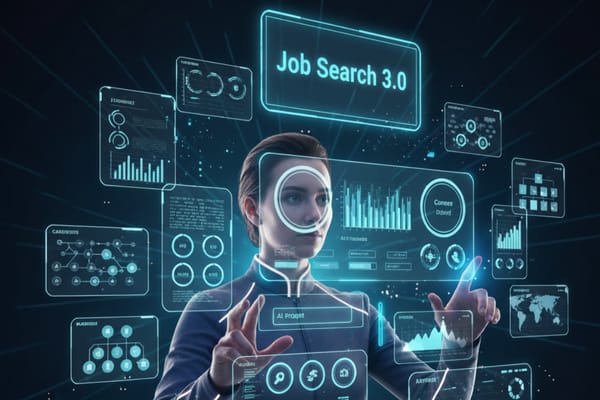
Layoffs end employment. They don’t end reputation.
Most laid-off employees are sent back into a job market that no longer works the way they were taught. Job Search 3.0 is an 11-module, AI-powered program companies use to help exiting employees attract opportunities that never hit job boards. It teaches modern visibility, recruiter discovery, and job-search strategy—without false promises or generic advice.
For employers, it’s a practical, scalable way to support transitions and protect employer brand when it matters most.
…
PART 2: The Performance Review That Ends Your Career

Recap & Escalation
In Part 1 of this series, we pulled back the curtain on a quiet revolution happening in plain sight. AI agents are no longer “just tools.” They are being formally integrated into organizations. They show up on org charts. They report to VPs. They are “hired” with job descriptions and performance goals. This is not a futuristic fantasy. It is present-day reality, with 25% of enterprises already testing agentic AI and 50% adoption forecast by 2027. The line between human employee and digital colleague has blurred.
Now we deal with what that blur creates. When you place an AI agent on an org chart next to a human, you invite comparison. Direct comparison. And when companies start measuring performance, the numbers land like a verdict: AI agents are not just better. They are orders of magnitude better on nearly every metric that matters. This is not a story about productivity gains. It is a story about existential obsolescence, told in the cold dialect of KPIs.
The Brutal Comparison: Human vs. AI Performance
Traditional recruiting KPIs have always measured human activity. Interviews conducted. Relationships built. Candidates sourced. But AI recruiting agents operate on a different plane, forcing a shift from what analysts describe as “volume to value-based metrics.” The new scorecard is not an improvement. It is a demolition of what used to count.
Performance Metric | Human Recruiter | AI Agent | AI Advantage |
|---|---|---|---|
Time to First Interview | 30–50 days | 7–10 days | 4–5x faster |
Outreach Reply Rate | 8–12% | 20–25% | 2–3x higher |
Interview-to-Offer Conversion | 30–40% | 35–45% | Equal or Better |
Cost per Hire | Variable (agency fees) | 50–80% reduction | Massive Savings |
Operating Hours | 40/week | 168/week (24/7) | 4.2x Capacity |
Learning Curve | Requires Training | Automatic Improvement | Self-Optimizing |
ROI per Hire | Baseline | 10x–20x | Exponential Value |
The Speed Advantage is Undeniable
Multiple independent sources show that AI‑driven recruiting compresses hiring from weeks to days. AI case studies report cutting time‑to‑hire from roughly 27 days to about 7 days after implementing AI screening and automation, putting AI‑orchestrated funnels in the 7–10 day range for some roles. Meanwhile, large‑scale benchmarks from Ashby and others place traditional, human‑led hiring at roughly 30–50+ days on average, with median time‑to‑hire of 32–41 days and many roles stretching to 50–60 days or more.
The Outreach Effectiveness is Staggering
Human recruiters, on average, achieve an 8–12% reply rate on outreach emails. AI agents, using personalized messaging driven by dynamic data, are seeing reply rates of 20–25%. More importantly, their interview-to-offer conversion rates are 35–45%, on par with or superior to the 30–40% achieved by human counterparts. The AI is not just reaching more candidates. It is converting them more effectively.
The Cost Performance is a CFO’s Dream
The financial case is the cleanest cut. AI recruiting solutions can reduce direct sourcing fees by 50–80% and offer predictable budgeting instead of variable agency percentages. The overall ROI per hire for AI solutions can reach 10x to 20x, including direct fee savings, internal labor savings, and the reduced opportunity cost of filling roles faster.
The Continuous Improvement Metric is Devastating
This is the metric that changes the temperature in the room. AI agents learn and refine their processes automatically from every interaction, a level of continuous optimization that human teams only achieve through explicit training and process updates. In other words, the AI gets better every day without scheduling a workshop. You improve through effort, reviews, and time. The AI’s growth is autonomous. Yours is deliberate.
The Question No One Wants to Ask
If an AI agent outperforms a human recruiter on every significant business metric, why would a rational company keep paying for the human? Run the numbers the way a CFO runs them.
A mid-level senior recruiter might cost $97,500 to $123,500 per year when salary and benefits are included. They work roughly 1,768 productive hours a year after weekends, holidays, vacation, and sick days.
An AI recruiting agent, by industry estimates, might carry an annual platform and customization cost of $30,000 to $50,000. It has no benefits. It operates for 8,585 productive hours a year, 24/7, with minimal downtime.
The calculation is cold because it is designed to be. The AI costs 40–60% less while delivering 4.8 times more working hours, while also performing 4–5 times faster on key metrics. The combined advantage is not marginal. It is 20–25x greater value per dollar spent. The 10x–20x ROI figures cited in industry studies are not exaggerations. If anything, they read conservative.
This Is Not Tomorrow’s Problem
If you think this is tomorrow’s problem, you are already behind. A 2025 Resume Now survey of over 900 U.S. workers, reported by HR Dive, reveals broad support for managers already using AI in critical personnel decisions: 73% back AI for hiring, firing, and budgeting, with more than half believing it outperforms humans on promotions, performance goals, and unbiased feedback.
The irony cuts deep—AI helps decide which humans advance, even as it competes with them for recognition. Imagine you’re a recruiter eyeing a promotion. Your manager, like many peers, relies on an AI performance system. Your time-to-fill averages 35 days; the AI’s hits 9. Your outreach reply rate is 10%; AI’s reaches 23%. Your cost-per-hire is $8,500; AI’s lands at $2,100. Who rises? The answer is obvious. The real question: who gets cut next?
The Career Path Absurdity: Promoting Software
This is where org charts start to feel like satire. Once AI sits beside humans, career progression has to exist for software. What does it mean for an AI agent to be “promoted”? Companies are grappling with it, and three primary models have emerged:
Capability Expansion: The AI agent is granted access to more systems, more data, and more decision-making authority. This mirrors a promotion through expanded responsibility, but functionally it is a permissions change.
Version Replacement: The AI agent is replaced by a newer, more powerful version. Less a promotion, more a termination and a new hire, with the accounting absurdity of depreciating an asset that just got “fired.”
Hybrid Evolution: The AI agent improves through continuous, autonomous learning within the same system. This most closely resembles human development, while blurring the line between a software update and genuine advancement.
This absurdity shows up in the rise of the Chief AI Officer (CAIO). Newer 2025 surveys, including IBM data cited across industry analyses, indicate 26–33% of large organizations now have a CAIO, up sharply from 11% in a 2023 study, with another 20%+ actively planning or recruiting for the role. Is this person managing AI, or managing the people who manage AI? The answer is both. And it points toward a future where your career path is less about becoming a better recruiter, and more about becoming a better manager of algorithms.
The Identity Crisis: What Are You When AI Is Your Peer?
This is where the numbers stop being abstract.
You are a senior recruiter with 15 years of experience. Your company adds “AI Recruiting Agent – Level 3” to the org chart. It reports to the same VP you do. Its metrics are superior. It works 24/7. It costs 60% less.
What is your value proposition now?
The proposed solution is to become a “Hybrid Worker” or an “Agent Boss,” aligned to the Frontier Firm model described by SAGlobal. You are no longer doing the work. You are managing the algorithm that does the work.
But it is temporary at best. It is middle management for software, and we all know what happens to middle management during a restructuring. Your new career path starts to look like a journey toward managing your own obsolescence.
Cliffhanger: The Legal Bomb About to Explode
We have established the performance reality. AI agents outperform humans on business-critical metrics. Companies are putting them on org charts, measuring them, and in some cases rewarding them over human employees. That alone is enough to raise anxiety in every white-collar role that lives inside spreadsheets and dashboards.
But there is a legal development that changes the stakes. A development that makes AI agents on your org chart not just a competitive threat, but a source of potentially catastrophic personal liability.
Emerging legal frameworks are beginning to treat the outputs of AI agents exactly like the actions of human employees. Which means when your new AI “colleague” makes a mistake, when it discriminates, when it violates regulations, when it causes financial harm, you could be held responsible. Personally. Legally. Financially.
As legal analyst Julio Pessan warned in a January 2026 article, the proposed framework treats AI agent outputs like employee actions. Meaning when your AI agent screws up, you are on the hook the same way you would be if a human made that call.
Oboy.
In Part 3 of this series, we will dive into the legal minefield. We will explore the landmark Mobley v. Workday case that established AI vendor liability, the patchwork of state regulations creating compliance chaos, and the “black box” problem that makes AI decisions nearly impossible to defend in court. We will ask the question that should keep you up tonight:
If you are legally liable for your AI colleague’s actions, but you cannot fully explain how it makes its decisions, how will you defend yourself in court? And more importantly, if the AI agent on your org chart discriminates, who goes to jail, you, your boss, the vendor, or all three?
Next week: "The Lawsuit Waiting to Happen: When Your AI Colleague Gets You Fired"
…
The Comics Section

…
One more thing before I go…

I look forward to attending the Evolve Conference later this month. Register now and meet me there. We’ll do lunch. ;-)
Okay, 2 things…
The Job Scam Report
Mark Anthony Dyson launched "The Job Scam Report" to help job seekers spot and avoid the growing wave of employment scams, which the FTC reports have cost hundreds of millions of dollars since 2023—often involving the theft of personal information through impersonated recruiters and hiring managers. He delivers twice-weekly updates on the latest scam tactics, treating this crisis not as a passing trend but as a full-blown pandemic. Subscribe today at markanthonydyson.substack.com for your first two weeks free, plus receive the exclusive guide "150 Easy Ways To Outsmart Job Scams In 2025." Stay one step ahead—join now!
…
And as always, hit reply and let me know how I’m doing. Or slide into my DMs as the kids say. All good.
…

Reply