- The Recruiting Life
- Posts
- The Lie Healthcare Keeps Telling Itself About Workplace Violence
The Lie Healthcare Keeps Telling Itself About Workplace Violence
How long can workers endure before they walk away?

Jim Stroud
April 05, 2026

The Recruiting Life Newsletter
The Healthcare industry keeps telling itself workplace violence is “rare.”
It’s not.
It’s underreported, normalized, and quietly absorbed to protect the system.
That’s the real problem.
Because when violence becomes “part of the job,”
silence becomes the policy.
And that’s where culture — and leadership — are failing.
If you think this is just a safety issue, you’re missing the bigger picture.
The reality is hard to ignore 👇
Brought to you by ProvenBase

Healthcare doesn’t just struggle with staffing.
It struggles with visibility.
What gets measured gets managed.
What gets seen gets addressed.
Everything else? Gets absorbed.
That same dynamic shows up in hiring.
Most recruiting systems reward visibility.
ProvenBase rewards proof.
Using Deep Search, ProvenBase surfaces candidates based on demonstrated skills, real-world context, and intent—not just who appears in the usual databases.
Because better decisions start with seeing what others miss.
👉 See how it works: provenbase.com
The Lie Healthcare Keeps Telling Itself About Workplace Violence

There’s a story healthcare tells itself.
It sounds responsible. Controlled. Reassuring.
Violence is rare.
Incidents are isolated.
We have protocols in place.
That story works.
Until you look closely.
Because inside hospitals, clinics, and emergency departments, something very different is happening.
And now, for the first time in a long time, the system is starting to see itself clearly.
Not through internal reports.
Through culture.
When Fiction Starts Documenting Reality
The Pitt isn’t just another hospital drama.
It’s a mirror.
In one of the most talked-about scenes, a nurse is assaulted by a patient. The violence is sudden, raw, and unsettling. But what lingers isn’t the incident.
It’s what happens after.
Hesitation.
Deflection.
Quiet pressure not to escalate.
Coverage from TVLine’s breakdown of the episode highlights how deliberately the show framed that moment. Not as shock value, but as commentary.
And in a later episode recap by The New York Times, the theme becomes even clearer: healthcare workers are expected to endure, not escalate.
That’s not fiction.
That’s pattern recognition.
Because the response in those scenes matches what frontline staff have been navigating for years.
The Reality No One Wants to Own
Healthcare workers are not just exposed to workplace violence.
They are disproportionately affected by it.
According to recent workplace violence statistics in healthcare, they are five times more likely to experience workplace violence than workers in any other industry. Nearly half of all nonfatal workplace violence injuries occur in healthcare settings.
This is not a marginal risk.
This is the environment.
The American Hospital Association reports that up to 76% of healthcare workers have experienced violence, ranging from verbal abuse to physical assault.
That’s not a signal.
That’s saturation.
The Iceberg Problem That Distorts Everything
If those numbers were fully visible, the response would be immediate.
But they’re not.
Because most incidents never make it into the system.
The American Nurses Association estimates that up to 88% of workplace violence incidents go unreported.
Which means leadership is operating on partial visibility.
What they see is controlled.
What staff experience is not.
This gap is where the real problem lives.
Because when data is incomplete, strategy is flawed.
And when strategy is flawed, behavior doesn’t change.
How Silence Gets Designed Into the System
Underreporting is often described as cultural.
That’s only half the story.
It’s engineered through incentives.
Healthcare workers are not passive participants in this system. They are navigating it.
They stay quiet because:
Reporting is time-consuming and often complicated
They believe nothing meaningful will happen
They fear retaliation or reputational damage
They have seen previous reports go nowhere
Even federal training materials from the CDC workplace violence prevention program acknowledge that fear of reporting and perceived lack of follow-through are major barriers.
But there is a deeper driver.
One that rarely gets discussed openly.
HCAHPS and the Pressure to Absorb
HCAHPS stands for the Hospital Consumer Assessment of Healthcare Providers and Systems.
It is a standardized, federally administered survey that measures patient perceptions of their hospital experience. These scores are publicly reported and tied to hospital reimbursement through value-based purchasing programs.
Which means HCAHPS is not just a feedback tool.
It is a financial lever.
And financial levers shape behavior.
Frontline staff understand this intuitively.
A negative patient interaction can impact scores. Scores impact rankings, funding, and leadership priorities.
So when a patient crosses the line, the decision is no longer simple.
Report and escalate, risking fallout.
Or de-escalate, absorb, and protect the system.
That tension shows up clearly in The Pitt, where staff are subtly discouraged from taking action that could create downstream consequences.
Not because leadership explicitly says so.
Because the system makes it understood.
“Part of the Job” Didn’t Start as a Belief. It Became One
Ask a nurse why they didn’t report an incident.
You’ll hear it.
“It’s part of the job.”
That phrase is the end result of repeated exposure to the same cycle:
Incident occurs
Report is discouraged or ignored
No meaningful action follows
Work continues
Over time, escalation feels pointless.
And normalization takes over.
Once that happens, violence stops being an exception.
It becomes background.
The Psychological Cost Compounds Faster Than Organizations Realize
Workplace violence doesn’t end with the incident.
It accumulates.
Research published in PubMed Central shows strong links between workplace violence and psychological distress, sleep disruption, and burnout.
The impact is layered:
Verbal abuse increases emotional exhaustion
Physical violence accelerates detachment
Repeated exposure erodes resilience
Eventually, people disengage.
And then they leave.
Nearly two in five healthcare workers are considering leaving their roles due to safety concerns.
This is not a staffing shortage problem.
It’s a retention failure driven by environment.
The Financial Cost Is Already Embedded in the System
For years, workplace violence was treated as a human issue.
Now it’s showing up as a financial one.
The American Hospital Association estimates that workplace violence costs U.S. hospitals over $18 billion annually.
That cost isn’t abstract.
It shows up in:
Turnover and replacement hiring
Lost productivity
Injury-related expenses
Security investments
Legal exposure
Organizations are already paying for the problem.
They’re just not addressing the cause.
HR Is Not Adjacent to This Problem. HR Owns It
Workplace violence is often framed as a clinical issue.
It’s not.
It’s a workforce system issue.
Which puts it squarely in HR’s domain.
HR determines:
How reporting systems function
How accessible they are
How leadership responds
What consequences are enforced
What behaviors are tolerated
If reporting is difficult, it won’t happen.
If responses are inconsistent, trust disappears.
If consequences are unclear, behavior continues.
HR is not observing this system.
HR is shaping it.
The Legal Environment Has Changed the Stakes
For years, organizations could operate in a gray area.
That’s disappearing.
The Tenth Circuit ruling affirming OSHA authority makes it clear that workplace violence falls under employer responsibility.
Legislation is advancing at multiple levels:
Federal action through the Workplace Violence Prevention Act (H.R. 2531)
State mandates like California SB 553
And the Joint Commission’s 2026 standards now require structured prevention programs, reporting systems, and leadership accountability.
This is no longer about best practices.
It’s about compliance.
Why Most Organizations Will Still Get This Wrong
Because they will treat it as a training problem.
More modules.
More policies.
More documentation.
None of which address the core issue.
This is not a knowledge gap.
It is a behavior gap.
If staff do not believe reporting leads to action, they will not report.
If leadership does not respond consistently, trust erodes.
If consequences are not enforced, behavior continues.
Effective intervention requires:
Frictionless reporting systems
Visible leadership accountability
Consistent enforcement
Environmental design changes
Sustained peer support
And increasingly, anticipation.
Research into AI-based violence prediction shows that signals of potential violence can be identified days in advance.
Which shifts the model from reaction to prevention.
The Real Problem Isn’t Violence
Violence is visible.
The system response is not.
The real issue is what happens after an incident.
Or more precisely, what doesn’t happen.
No reporting
No accountability
No structural change
Just normalization.
The Turning Point
Every industry reaches a moment where denial stops working.
Healthcare is there.
The data is too consistent.
The financial impact is too large.
The workforce is too strained.
The legal pressure is too real.
And the narrative is shifting.
From minimization…
To exposure.
Final Thought
Healthcare workers chose this profession to help people.
They did not choose to absorb violence as a condition of employment.
But for years, the system has quietly required both.
That balance is breaking.
And when it does, the organizations that failed to act won’t just face a workforce crisis.
They’ll face a trust crisis.
And those are much harder to recover from.
The HR Blotter
AI Cuts First, Asks Questions Later in U.S. Layoff Surge - AI is no longer coming for jobs—it’s here, cutting deep, and now leads U.S. layoffs as companies gut payrolls to fund machines. What started in tech is spilling fast into transportation, healthcare, and beyond, turning isolated cuts into a full-blown white-collar bleed. The message is blunt: headcount is out, AI is in, and the workforce is getting reshaped in real time.
The Snitch Bot Era Begins Inside Corporate America - Meet Junior—an AI coworker that doesn’t just help, it watches, nudges, and escalates, turning every missed task into a reportable offense. Companies are lining up anyway, betting on a tireless, always-on operator that already handles most comms, code, and workflow without blinking. Call it augmentation if you want, but when AI starts owning entry-level work, the ladder up is getting pulled away.
The Boss Is a Bot—and Workers Are Starting to Accept It - Americans aren’t just fearing AI—they’re starting to accept it as the boss, with 15% willing to take orders from an algorithm. Companies are already flattening management, cutting human supervisors while handing oversight to machines that schedule, approve, and decide. The result is a colder reality: fewer managers, fewer jobs, and a workplace where the chain of command runs through code.
AI Slashes Companies to One Human and a Machine - AI is collapsing companies down to a single operator, turning one person into an entire workforce while wiping out layers of hiring. China is accelerating it with state-backed solo founders, while top talent in the U.S. is ditching jobs to build independently and disappear from traditional recruiting. The new reality is brutal: fewer entry points, invisible talent, and a job market where the best people aren’t even looking.
The Workforce Flips as Male-Dominated Jobs Collapse - Women are back on top of the workforce numbers—but not because they’re surging, because men are slipping. Growth in healthcare and other female-heavy sectors is propping things up while male-dominated industries stall out. It’s not a clean win—it’s a reshuffle, with fragile gains and the same old pressures still sitting underneath.
…
The Jim Stroud Podcast
Not subscribed to The Jim Stroud Podcast? Then you’ve been flying blind. Here’s a sneak peek at the latest episode debuting tomorrow.
…
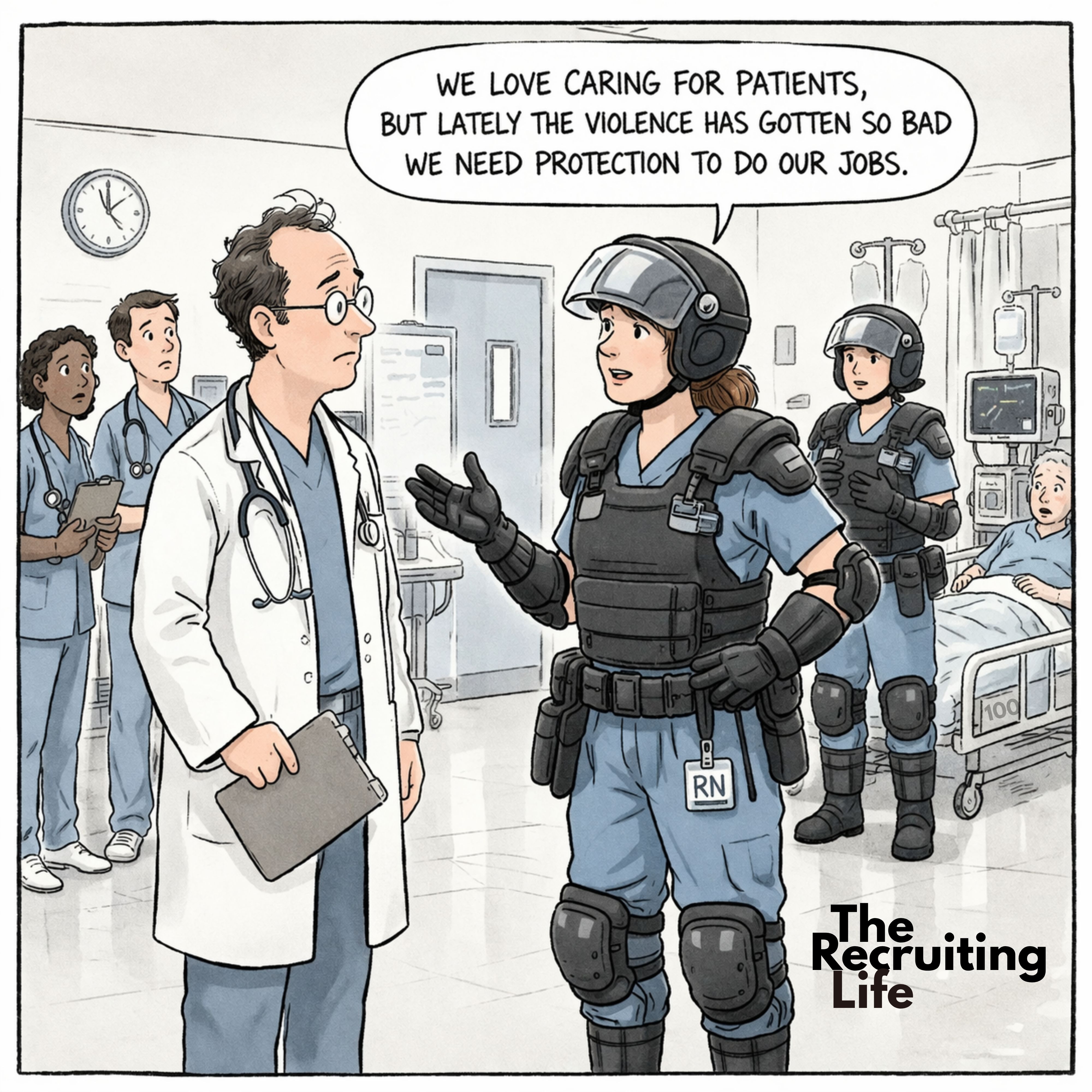
The Comics Section
…
One more thing before I go…
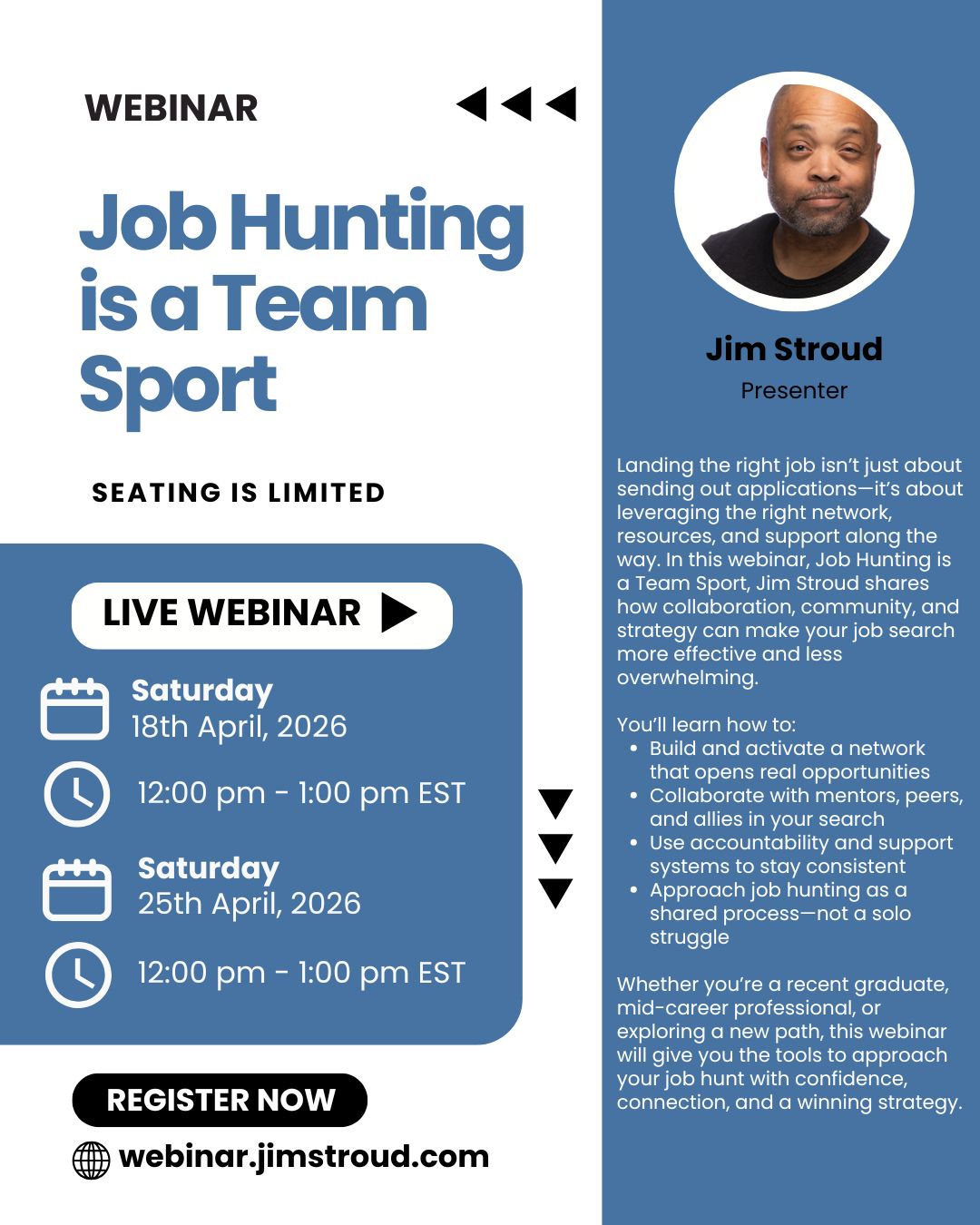
Job hunting isn’t a solo grind—it’s a team sport. 💼🤝
In Job Hunting is a Team Sport, Jim Stroud shares how to build a strong network, stay accountable, and turn connections into real opportunities.
Whether you’re a grad or making a career pivot, get the strategy + support you need to win.
Register now:
Job Hunting is a Team Sport
April 18th at 12:00 pm EST
April 25th at 12:00 pm EST
https://webinar.jimstroud.com
…

Reply