- The Recruiting Life
- Posts
- The $60 Trillion War


The Recruiting Life is brought to you by: ProvenBase

The Recruiting Life Newsletter
Read this carefully.
A startup backed by some of the most influential names in tech has a single, explicit goal:
Replace human labor.
Not “help.”
Not “assist.”
Replace.
They’ve defined their market as human wages — about $60 trillion a year globally.
If you’re reading this, you’re not watching from the sidelines.
The agents are already on the org chart.
The legal, economic, and moral consequences are unfolding now.
The only thing left undecided is how fast this happens.
The full breakdown is here.👇

Most recruiting systems reward visibility.
ProvenBase rewards proof.
If your team keeps revisiting the same candidates while roles stay open, the issue isn’t talent availability.
It’s how the market is being searched.
ProvenBase uses Deep Search to surface candidates based on demonstrated skills, real-world context, and intent—not who markets themselves best or happens to sit in the usual databases.
The result: broader pipelines, less noise, and faster access to people who can actually do the work.
This isn’t another sourcing tool.
It’s a different view of the talent market.
👉 See how it works: provenbase.com
The HR Blotter
How Managers Push You Out Without Ever Firing You - Quiet firing is when managers don’t terminate employees—they squeeze them until they quit. More than half of U.S. business leaders admit to using tactics like stalled raises, impossible workloads, and silent exclusion to push people out while dodging severance and legal risk. The damage is psychological, slow, and destabilizing, leaving workers doubting themselves while the company keeps its hands clean.
Its not a good day to be Eightfold - The Eightfold lawsuit puts AI hiring tools on the stand over whether “talent matching” is really unregulated people scoring. Plaintiffs face legal uncertainty, but Eightfold’s own marketing admits to deep profiling, third-party data enrichment, and invisible evaluations applicants can’t see or challenge. If courts bless this model, FCRA becomes optional in the AI age; if not, black-box hiring gets dragged into the light.
xAI Says OpenAI Isn’t Hiring, It’s Hunting - Elon Musk’s xAI is suing OpenAI, accusing it of poaching employees to siphon trade secrets tied to Grok and other core technologies. The complaint paints OpenAI’s hiring as a coordinated effort to extract confidential information, a claim OpenAI flatly denies while framing the suit as harassment. The lawsuit escalates a long-running feud between Musk and OpenAI into a full-blown talent-and-IP war.
Amazon’s Historic Layoffs Expose a Corporate Reset, Not Just Cost Cutting - Amazon has laid off about 16,000 corporate employees, pushing total recent cuts to roughly 30,000—the largest workforce reduction in its history. The company says the move targets excess management layers and post-pandemic bureaucracy rather than finances or AI, though automation and generative AI loom over the decision. Together, the layoffs signal a major reset as Amazon streamlines for slower growth and an AI-heavy future.
Job Market Stays Hot, AI Anxiety Grows, and 2026 Hiring Takes Shape - iCIMS’ January 2026 Workforce Report finds job openings and applications stayed unusually strong into year-end, signaling a fluid labor market heading into 2026. Hiring growth was led by healthcare, transportation and manufacturing, while job seekers showed cautious optimism and rising interest in switching roles. Employers are betting heavily on AI to boost recruiting efficiency, even as concerns over compliance, bias and trust intensify.
…
The Jim Stroud Podcast
Not subscribed to The Jim Stroud Podcast? Then you’ve been flying blind. Here’s a sneak peek at the latest episode debuting tomorrow.
…
A Smarter Way to Support Employees You’re Letting Go
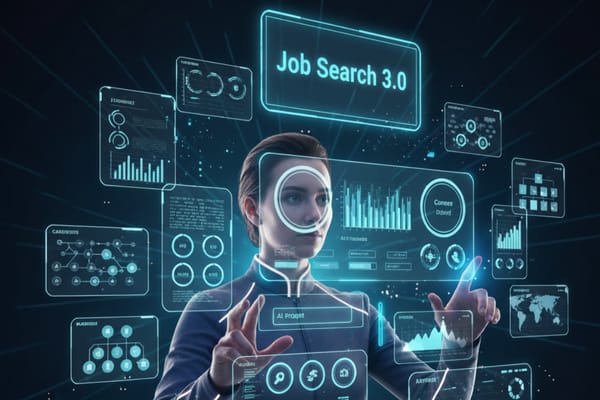
Layoffs end employment. They don’t end reputation.
Most laid-off employees are sent back into a job market that no longer works the way they were taught. Job Search 3.0 is an 11-module, AI-powered program companies use to help exiting employees attract opportunities that never hit job boards. It teaches modern visibility, recruiter discovery, and job-search strategy—without false promises or generic advice.
For employers, it’s a practical, scalable way to support transitions and protect employer brand when it matters most.
…
This. Is. The. Endgame.
At this point, the pattern is hard to miss.
In Part 1, we established that AI agents are already being placed on org charts and managed like employees.
In Part 2, we looked at performance data showing those agents are 10x to 20x more effective than humans doing the same work.
In Part 3, we crossed into legal territory and saw something uncomfortable: if an AI agent harms someone, you, not the vendor, may be on the hook.
Now comes the final question.
Not whether AI will change work.
Not whether it will augment humans.
But what happens when the explicit goal is to eliminate human labor entirely?
What happens when every wage earner becomes nothing more than a line item in someone else’s “Total Addressable Market?”
That war has already started. And the prize is roughly $60 trillion a year.

The Company That Said the Quiet Part Out Loud
On April 19, 2025, AI researcher Tamay Besiroglu launched a startup called Mechanize.
Its stated mission is not ambiguous.
“The full automation of all work.”
“The full automation of the economy.”
Not assistance.
Not copilots.
Not productivity tools.
Replacement.
TechCrunch wasn’t sure whether to treat the announcement as real or satire.
It turned out to be very real.
Besiroglu didn’t define his market by industry or function.
He defined it by human wages.
“Workers in the US are paid around $18 trillion per year in aggregate.
For the entire world, the number is over three times greater, around $60 trillion per year.”
That number is not abstract.
It’s your salary.
Your team’s payroll.
Your department’s cost center.
And when pressed, Besiroglu was clear about where Mechanize would start: white-collar work.
If you’re reading this, you’re not watching from the sidelines.
Mechanize is not a fringe experiment.
Its backers include Nat Friedman, Daniel Gross, Patrick Collison, and Jeff Dean.
This is not a rebellion against the tech establishment.
It is the establishment.
The Defense: “Rents, Dividends, and Welfare”
When asked what happens to people once their wages disappear, Besiroglu’s answer was calm, confident, and revealing:
“Even in scenarios where wages might decrease, economic well-being isn’t solely determined by wages. People typically receive income from other sources—such as rents, dividends, and government welfare.”
Read that again.
The future being described is not one where everyone becomes more creative or fulfilled.
It’s a two-tier economy.
If you own capital, you receive rents and dividends.
If you don’t, you receive transfers.
This isn’t an accidental outcome. It’s the logical consequence of replacing labor with systems owned by a small group of firms and investors.
Anthony Aguirre said it plainly:
“The automation of most human labor is indeed a giant prize for companies…
I think it will be a huge loss for most humans.”
One more detail matters here.
Besiroglu is also the founder of Epoch AI, an organization positioned as a neutral authority on AI benchmarks and progress.
The people measuring AI safety are now openly building companies to remove humans from the economy.
That conflict is not theoretical.
Labor Pushes Back—For Now
Faced with this trajectory, labor organizations are doing what they can.
In December 2025, the NewsGuild-CWA won a landmark arbitration ruling against POLITICO. Management had deployed AI tools without bargaining and without sufficient human oversight.
In January 2025, the International Longshoremen’s Association secured contract language requiring negotiation before automation could be introduced.
The strategy is consistent:
advance notice,
human oversight,
bargaining rights.
Not because unions are anti-technology, but because unchecked automation collapses accountability and quality. As the NewsGuild put it: “News, Not Slop.”
These wins matter.
They also buy time, not resolution.
The Math Problem No One Wants to Solve
In November 2025, McKinsey published an analysis estimating that 57% of U.S. work hours are already automatable today.
Not “soon.”
Not “with future breakthroughs.”
Now.
McKinsey emphasizes the “durability of human skills.” That optimism sounds reasonable—until you pair it with exponential improvement curves and economic incentives measured in tens of trillions.
If more than half of all work can already be automated, the argument that this is a distant problem collapses.
This isn’t a 20-year transition.
It’s a 3-to-5-year compression.
The Three Paths Ahead (None Are Comfortable)
If AI agents on org charts become standard within the next 12–24 months, the choices narrow quickly.
Path One: Become the Agent Boss
You manage AI systems. You gain leverage. You also help train the systems that eventually replace you. This delays displacement. It does not prevent it.
Path Two: Resist Through Policy and Unions
You fight for oversight, limits, and negotiation rights. You may win temporary protections, but you’re pushing against a $60 trillion incentive structure.
Path Three: Treat AI as a Tool Only
You insist on augmentation, not autonomy. Your firm moves slower. Your competitors don’t. Eventually, the market decides for you.
Each path buys time. None remove the underlying pressure.
The Question That Won’t Go Away
From a purely financial standpoint, the argument is brutal and simple.
AI agents cost less.
They work more hours.
They scale instantly.
They improve continuously.
For executives accountable to shareholders, automation is increasingly framed not as an option, but as a fiduciary duty.
Which leaves one question that no strategy deck seems willing to answer:
If AI can already perform more than half of all work,
if its capabilities are compounding,
and if the most powerful people in technology are explicitly funding the removal of human labor…
What is the case for why your job is different?
Not jobs in general.
Not society.
Yours.
What makes your role indispensable when a system works 24/7, costs less, delivers higher output, and never stops learning?
I don’t have a clean answer.
And if we’re being honest, most organizations don’t either.
The agents are already on the org chart.
The only unresolved variable is timing.
In an economy that increasingly doesn’t need workers, how do you stay relevant?
…
The Comics Section
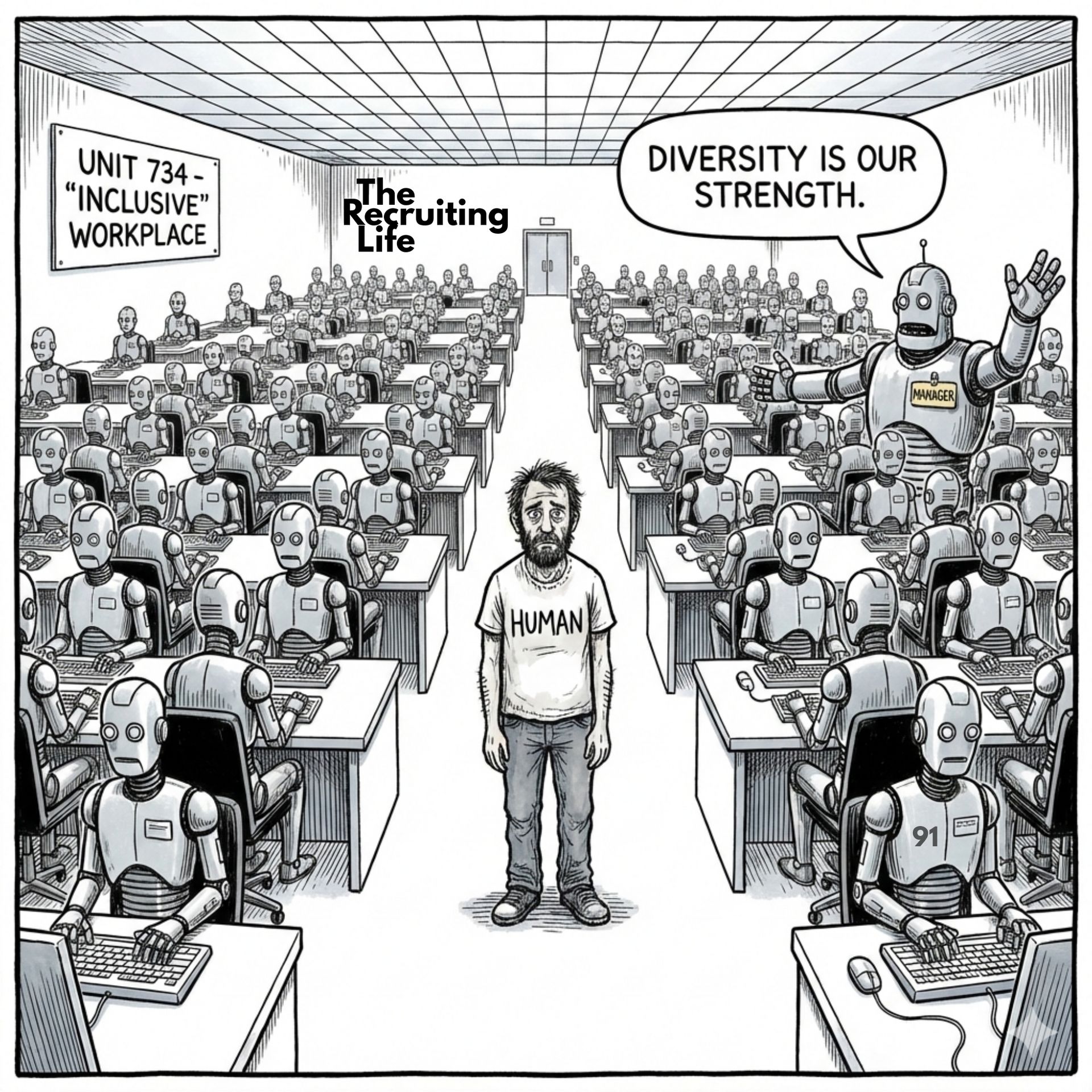
…
One more thing before I go…
I’ve grown more cynical with time.
Watching AI reshape work will do that. The incentives are clear. The momentum is real. And the anxiety isn’t irrational.
But one question keeps me from going full doom-spiral:
If AI takes all the jobs, who buys the products and services companies need to survive?
That question exposes the flaw in pure automation logic. Labor isn’t just a cost. It’s also demand.
I’m going to sit with that this week and write through it for the next newsletter.
It doesn’t solve everything.
But it’s enough to take the edge off.
Okay, 2 things…
If you were not at the Evolve conference - YOU MISSED SOMETHING SPECIAL! Check out the recent tweets on my Twitter/ X account to get a peek behind the curtain at what you missed. And this guy, this guy… please support him! He is on the side of the angels.
…
And as always, hit reply and let me know how I’m doing. Or slide into my DMs as the kids say. All good.
…

Reply