- The Recruiting Life
- Posts
- Same Race. Same Workplace. Still Illegal.
Same Race. Same Workplace. Still Illegal.
The Myth of the “Same-Race Defense” Is Over

Jim Stroud
March 22, 2026

The Recruiting Life Newsletter
When people think about workplace discrimination, they picture something obvious.
A white manager mistreating a Black employee.
A man harassing a woman.
Different groups. Clear lines.
But the law does not work that way.
Because sometimes, the person doing the harassment looks just like you.
Same race. Same background. Same identity.
And yes, it still counts. 👇
Sponsored by Career Intelligence Weekly
Most people misunderstand how the job market works.
They wait for a job posting.
They apply.
They hope.
By the time a role shows up on a job board, the real decisions have already been made.
Just like most people misunderstand how discrimination works, they misunderstand how hiring works.
The signal is there.
It’s just not where most people are looking.
Career Intelligence Weekly breaks down what’s actually happening behind the scenes.
Hiring signals hidden in business moves.
Layoffs that quietly create new roles somewhere else.
Industry shifts that tell you where opportunity is forming before anyone says it out loud.
Each issue connects the dots between headlines and reality.
Where roles are opening before they’re posted.
Which companies are about to hire.
And what smart professionals are watching right now.
If you want to see what others miss, you have to look where others don’t.
Same Race. Same Workplace. Still Illegal.
Disclaimer:
I’m not a lawyer. Never played one on TV either.
This is insight, not legal advice.
If your job, your reputation, or your paycheck is on the line, don’t guess your way through it. Talk to a real employment lawyer.
Most People Get This Wrong
When people think about workplace discrimination, they picture something obvious.
A white manager mistreating a Black employee.
A man harassing a woman.
Different groups. Clear lines.
But the law does not work that way.
Because sometimes, the person doing the harassment looks just like you.
Same race. Same background. Same identity.
And yes, it still counts.
The Law Does Not Care If You “Match”
At the center of all of this is Title VII of the Civil Rights Act of 1964.
It prohibits discrimination based on race, color, religion, sex, or national origin.
Simple enough.
But here is where things get more nuanced.
The law does not say discrimination only happens between different groups.
It says discrimination cannot happen because of a protected characteristic.
That distinction matters.
The Case That Defined “Hostile Work Environment”
Let’s start with a foundational case:
Harris v. Forklift Systems (1993)
What happened?
An employee experienced repeated abusive behavior at work. Not necessarily physical. Not always extreme. But persistent enough to affect how she experienced her job.
The Supreme Court stepped in and clarified something critical:
A workplace violates the law when it becomes filled with intimidation, ridicule, or insult that is severe or pervasive enough to change working conditions.
That standard applies across the board.
Race included.
Same race included.
The Case That Changed Everything
Now here is where things really shift.
Facts:
A male oil rig worker was harassed by other men.
Lower courts said, “This cannot be discrimination. They are all men.”
The Supreme Court disagreed.
Justice Antonin Scalia made it clear:
Discrimination is not about whether people share the same identity.
It is about whether the behavior happened because of that identity.
That ruling did something important.
It quietly eliminated the idea that “same group” equals “no discrimination.”
And that logic carries directly into race.
The “Same-Race Defense” Is Falling Apart
For years, companies tried to argue this:
“If both people are the same race, it cannot be racial discrimination.”
That argument is now collapsing.
A recent case makes that very clear.
Facts:
Two Black truck drivers said they were subjected to racial slurs at work.
One of the supervisors using those slurs was also Black.
A lower court dismissed the case.
Why?
They assumed shared race weakened the argument that the behavior was racist.
The appeals court reversed that decision.
Hard.
They said:
Racial slurs do not lose their meaning just because the person saying them shares the same race.
History still matters. Language still carries weight.
That ruling reinforced a key idea:
Intent and impact matter more than identity alignment.
Another Important Shift
The Supreme Court clarified something broader:
Title VII protects any individual.
No special rules. No higher burden depending on who you are.
Everyone plays by the same standard.
What Courts Actually Look For
If someone brings a same-race harassment claim, they still have to prove three things:
1. The behavior was unwelcome
Not joking. Not mutual. Not invited.
2. It happened because of race
This is where language, tone, and context matter.
Racial slurs are often enough on their own.
Patterns of behavior also matter.
Who gets targeted. Who does not.
3. It was severe or pervasive
Not one awkward comment.
A pattern. A tone. A workplace that shifts from professional to hostile.
Courts look at:
Frequency
Severity
Whether it was humiliating or threatening
Whether it affected job performance
Where This Gets Even More Complicated: Colorism
Not all bias is obvious.
Sometimes it shows up within the same racial group.
This is called colorism.
Example:
A lighter-skinned employee mistreating a darker-skinned colleague.
Or the reverse.
Title VII explicitly includes color as a protected category.
So yes, discrimination within the same race based on skin tone is actionable.
And it happens more often than companies want to admit.
What This Means for Employers
This is where most organizations get exposed.
Because many policies are written as if discrimination only happens across groups.
That is outdated thinking.
Here is what actually matters now:
1. Policies must be explicit
Same-race harassment must be clearly included. No ambiguity.
2. Training must evolve
Managers need to understand that shared identity does not equal harmless behavior.
3. Investigations must be objective
You cannot dismiss a complaint just because “they are the same race.”
That assumption will cost you.
4. Enforcement must be consistent
If rules are applied unevenly, that creates another layer of liability.
The Real Takeaway
The law has moved past surface-level thinking.
It is no longer about who people are on paper.
It is about:
What was said
What was done
How it impacted the employee
Same race does not protect anyone.
Shared identity does not erase harm.
And courts are making that clearer with every case.
Why This Matters for the Future of Work
This is bigger than legal compliance.
It changes how we think about workplace culture.
Because bias is not always external.
Sometimes it is internal. Subtle. Learned. Repeated.
And if companies are serious about building equitable systems, they cannot ignore that reality.
The uncomfortable truth is this:
Discrimination is not defined by difference.
It is defined by behavior.
And the system is finally catching up to that.
The HR Blotter
China Floods the Zone With One-Person AI Startups - China is flooding the zone with subsidies and free infrastructure to mass-produce one-person AI startups. Idle data centers and empty offices are being repurposed into incubators as cities battle to recruit solo builders. It’s a high-stakes jobs patch for laid-off tech workers—fast momentum, uncertain payoff.
DoorDash Mines Its Gig Army to Train the Machines - DoorDash is mining its gig army for raw training data, paying couriers to film chores, scan stores, and capture the messy real world for AI systems. The new Tasks app turns everyday labor into fuel for automation, feeding models that power robots and chatbots. Workers get short-term cash; companies get the data to replace them.
PwC to Partners: Get AI-First or Get Out - PwC is ripping up its old playbook, warning partners: get AI-first or get out. The firm is killing billable hours, packaging its expertise into automated tools, and selling outcomes on subscription. Fewer junior grunts, more engineers—and a business model fighting to survive the machines.
ATMs Helped Tellers. The iPhone Buried Them - ATMs didn’t wipe out tellers—they made them cheaper and more useful, so banks hired more. The iPhone finished the job by killing the branch and dragging banking into the app, where tellers don’t exist. The takeaway is brutal: automation trims roles, but new paradigms delete them.
US Hiring Hits Zero—and the Fed Calls It Fine - Job creation in the US has hit a wall, effectively flatlining as the labor force stops growing. Powell calls it “stable,” but hiring demand is clearly weakening beneath the surface. It’s a labor market running in place—with no fuel left.
…
The Jim Stroud Podcast
Not subscribed to The Jim Stroud Podcast? Then you’ve been flying blind. Here’s a sneak peek at the latest episode debuting tomorrow.
The Benefit No One Sees—Until Your Best Employee Quits #elderlycare #eldercare #employeebenefits
In this episode: Your best employees aren't quitting for more money — they're quitting for relief. Tens of millions of workers are quietly carrying an invisible second job: caregiving. And it's burning out your most valuable people from the inside out.
…
The Comics Section
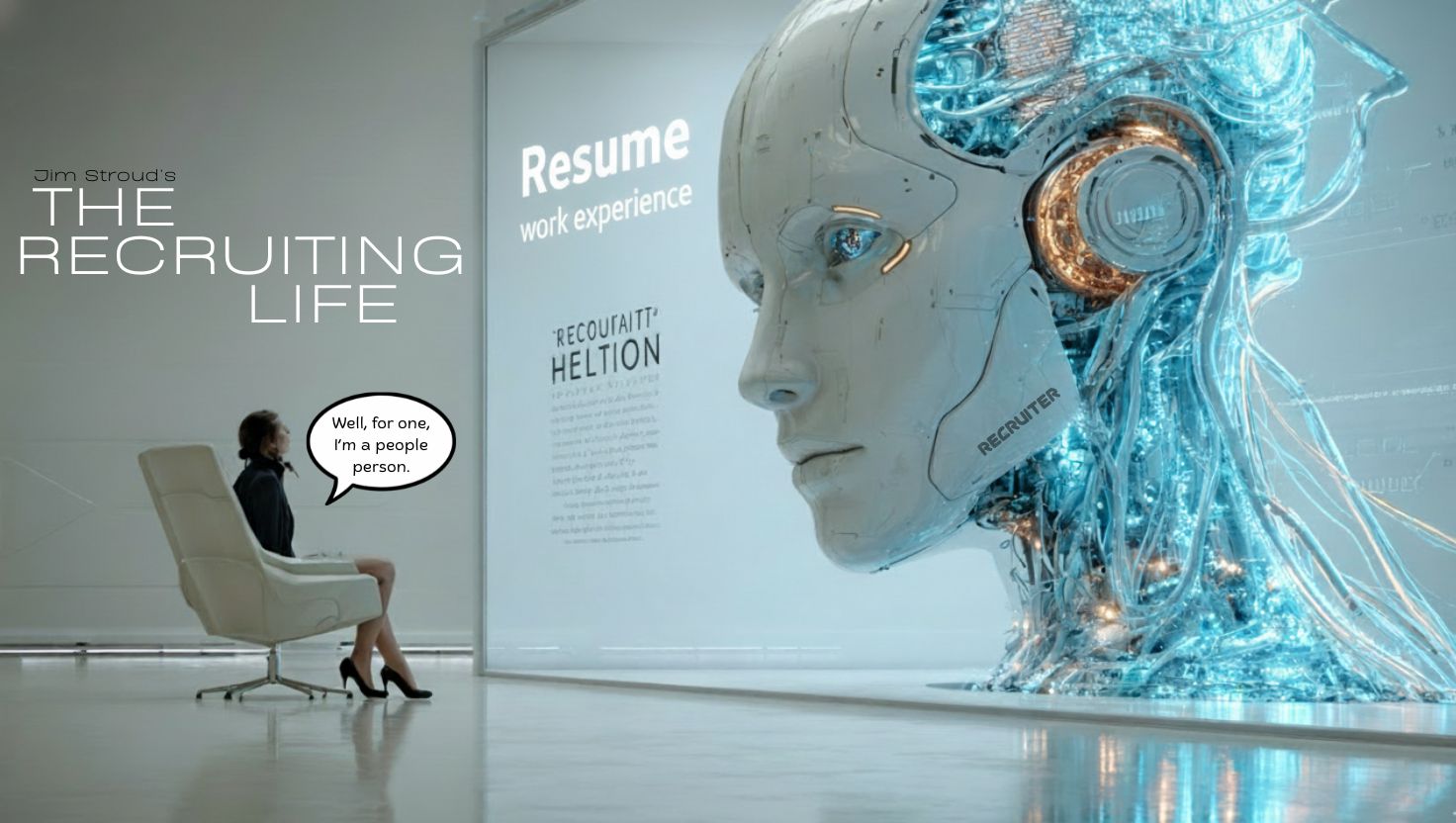
This week’s comic inspiration: A 2025 analysis of large U.S. firms reported women make up only about 28–29% of all executives in top leadership teams (C‑suite level) in the S&P 100.

…
One more thing before I go…
The results are in and it looks like most of you are ok with AI. Good to know.

Okay, 2 things…
Who else besides me is going to the Recruiting Innovation Summit? (May 5-6, 2026) Reply back and let me know.
…

Reply