- The Recruiting Life
- Posts
- Portfolio Professionals & The End of the Full-Time Employee
Portfolio Professionals & The End of the Full-Time Employee
The 40-hour job is no longer the default—it’s the constraint.

Jim Stroud
November 30, 2025
The Recruiting Life is brought to you by: Job Search 3.0 - Stop applying. Start attracting.

The Recruiting Life Newsletter
In this issue:
The 40-hour job is no longer the default—it’s the constraint.
Today’s top talent isn’t climbing one ladder; they’re building entire portfolios of roles, skills, and income streams.
From fractional work to multi-role careers, the “full-time employee” model is quietly dissolving—and both professionals and employers are rewriting the rules in real time.
If you’re still thinking in titles and org charts, you’re already behind.
The future belongs to the portfolio professional—and the companies flexible enough to work with them, not own them.
Ready for what’s next?
Read on.
…
The HR Blotter
Tech’s New Fear: Betting the Future and Losing the Present - Everyone in tech keeps chanting the same mantra—better to overspend on AI than fall behind. But the Wall Street Journal points to Intel’s collapse as a warning: bet too big on infrastructure before the payoff arrives, and you can bleed out fast. For workers, it’s proof that AI gold rush budgets can flip overnight, turning today’s hiring frenzy into tomorrow’s layoffs.
The AI Delusion at the Top Floor - Executives keep telling themselves their people are excited about AI, but the numbers say otherwise. Harvard Business Review shows a gap wide enough to lose a whole workforce in—leaders see optimism, while frontline workers feel fear, confusion, and zero say in the rollout. In a market this unstable, ignoring that split doesn’t just sink morale, it kills AI adoption before it even starts.
The Succession Silence Inside America’s Family Businesses - A new survey shows most business owners are stalling on succession plans because they don’t trust the next generation to carry the weight. Nearly half say their heirs aren’t ready, so they keep the real plans locked away, worried about entitlement, family strife, or losing control too soon. In the quiet corners of the economy where private businesses keep towns alive, the handoff is becoming the hardest job of all.
The ‘Boring’ Job Becoming Gen Z’s Six-Figure Shortcut - Fortune reports that a job millennials and boomers quietly walked away from—package handling—has become the hottest seasonal role in the country, with Gen Z flooding into warehouses for fast paychecks and a path to six-figure logistics careers. What used to be dismissed as “boring work” now looks like a backdoor into real money and rapid advancement. In an economy this unpredictable, the unglamorous jobs are the ones rewriting the playbook.
October Layoffs Hit Two-Decade High — 153,000 Jobs Cut - October 2025 wasn’t just rough — it broke records. U.S. businesses announced over 153,000 layoffs, the worst October for job cuts in more than two decades, driven by cost-cutting, soft demand, and AI-driven restructuring. For workers and HR leaders, the layoffs are a clear signal: the “no-hire, no-fire” era is over, and the next few quarters won’t feel anything like normal.
…
The Jim Stroud Podcast
Not subscribed to The Jim Stroud Podcast? Then you’ve been flying blind. Here’s a taste of what they’ve been hearing—while you’ve been missing it.


…
Job Search 3.0

🚀 Stop Competing. Start Getting Noticed.
Over 80% of great jobs are never posted online — which means if you’re still relying on job boards and endless applications, you’re already behind.
Job Search 3.0 changes that.
This 11-module, 6+ hour program is designed for ambitious professionals who are ready to stop chasing opportunities — and start attracting them.
You’ll learn a proven system to build a standout professional brand that gets you discovered, no matter what’s happening in the economy.
Study at your own pace. Start now.
…
Portfolio Professionals & The End of the Full-Time Employee

It’s 10 a.m. on a Tuesday.
A senior digital marketer is on a Zoom call with a tech firm, walking a VP through a launch plan.
By 2 p.m., she’s ghostwriting UX copy for a fintech startup.
By nightfall, she’s consulting for a non-profit—crafting their content strategy with the same precision she once reserved for quarterly reports.
She doesn’t have a job.
She is the job.
Welcome to the age of the portfolio professional—a worker whose ambition no longer fits inside a single company. The forty-hour week, once a symbol of stability, now feels like a constraint from another century.
This isn’t rebellion. It’s evolution.
The Shift: From Ladder to Portfolio
We’re watching the full-time employee model erode in real time.
The nine-to-five job—steady, loyal, singular—is being replaced by something fluid: a mix of overlapping projects and parallel identities.
As of August 2025, 5.2% of the U.S. workforce—about 8.5 million people—held more than one job, according to the U.S. Bureau of Labor Statistics (BLS, 2025). That figure has stabilized at post-pandemic highs, signaling not a glitch but a permanent recalibration.
And the reasoning goes deeper than money.
The ADP Research Institute’s People at Work 2025 report shows younger professionals deliberately building multiple income streams—not just to survive inflation, but to expand skills and guard against volatility (ADP Research Institute, 2025).
It’s the realization of an idea first articulated in the 1990s by philosopher Charles Handy, who predicted the rise of “portfolio careers”—a model where individuals cultivate multiple, portable skills rather than anchoring their entire worth to one employer (Wikipedia, n.d.).
That prophecy has come due.
For Job Seekers: Building a Career That Can’t Be Downsized
The new career isn’t linear—it’s layered. It’s not about climbing; it’s about stacking.
Here’s what that means:
1. Embrace the Portfolio Mindset
You’re not an employee—you’re a brand with clients. Each job is a contract in your ecosystem. Treat your career like a diversified portfolio, not a single stock.
2. Brand Yourself by Capability Clusters
Titles are dead weight. Don’t be “just” a Project Manager. Be a Digital Marketer / UX Writer / Strategist.
Group your strengths around outcomes, not org charts.
3. Master Self-Management
You are your own operations department now.
Know your capacity, communicate your boundaries, and automate what you can. Burnout is the tax for poor planning.
Those who master this approach gain what traditional employees rarely do—financial resilience and creative sovereignty. Their careers don’t end with layoffs. They simply reallocate focus.
For Employers: Rethinking Talent Strategy
The old playbook—hire one person, keep them forever—no longer applies.
Top talent isn’t pledging allegiance to companies anymore; they’re curating partnerships.
Old Model | Portfolio Model |
|---|---|
Full-time, 40-hour exclusive roles | Fractional or project-based roles (0.5–0.7 FTE) |
Retention = loyalty | Retention = meaningful inclusion in a portfolio |
Rewards = salary + benefits | Rewards = flexibility, autonomy, and skill-building |
Risk control = ban outside work | Risk control = clarity, monitoring, burnout support |
This evolution demands structural change.
Can a 40-hour role be split into two 20-hour fractional positions?
Can your company host an internal gig marketplace, where employees take on stretch projects across departments?
Forward-thinking companies like Oyster HR are already exploring fractional work as part of talent strategy, creating hybrid models where flexibility attracts top-tier specialists (Oyster HR, 2024).
Others, like TalentWorld, frame flexible work not as a perk but as a competitive necessity for 2025 and beyond (TalentWorld, 2025).
The End of Employment Monogamy
Let’s stop pretending exclusivity still exists.
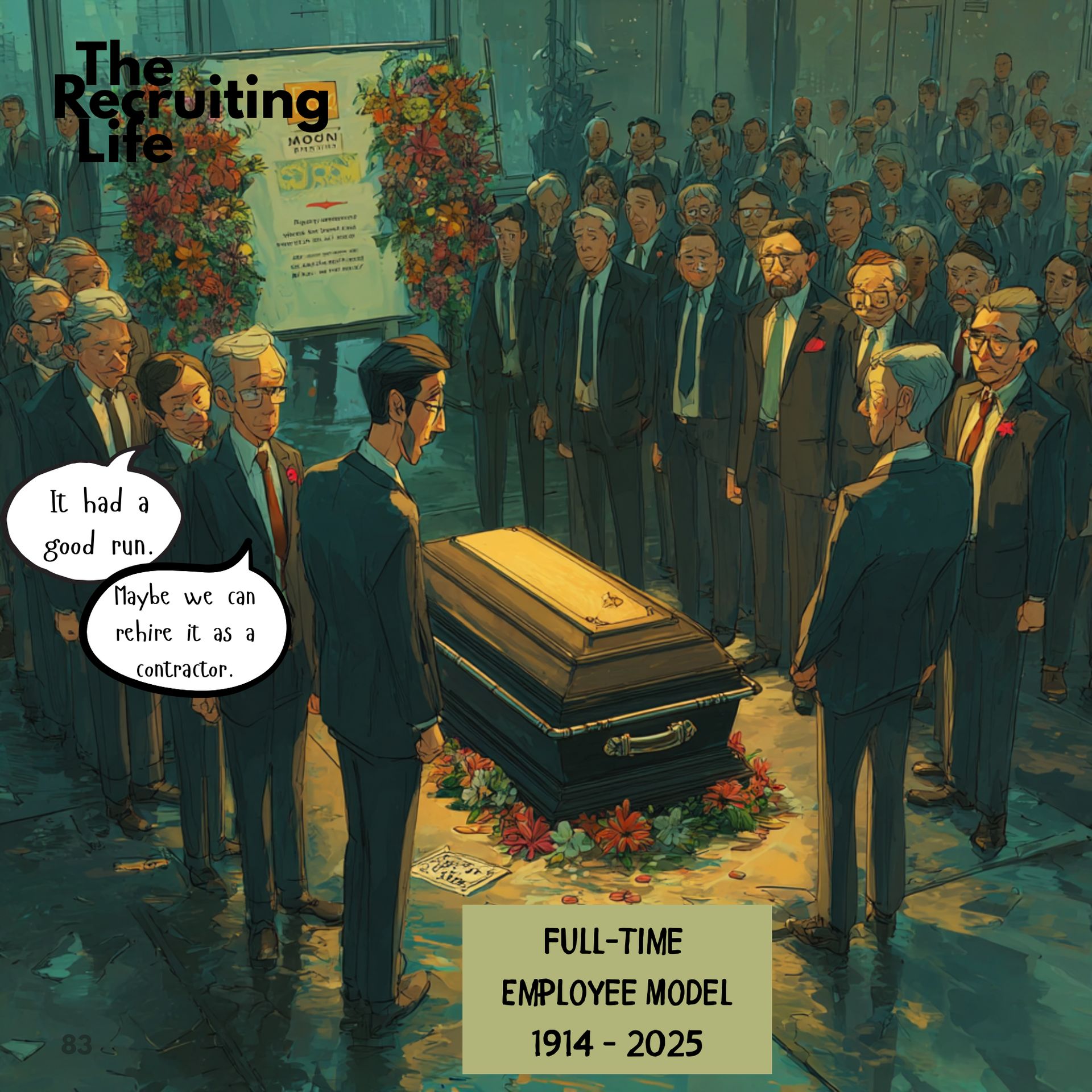
The “one company for life” model is gone—buried somewhere between the fax machine and the gold watch.
We’ve entered the era of employment polygamy, where professionals maintain several long-term commitments simultaneously.
For employers, demanding exclusivity is corporate self-sabotage. The best talent won’t play that game. They’ll work for your competitor who offers freedom instead of fences.
For job seekers, blind loyalty is career suicide. The company that lays you off on Friday won’t remember your sacrifice on Monday.
Adaptation isn’t betrayal. It’s survival.
Action Plan: Thriving in the New Economy
For Job Seekers (Portfolio Professionals)
Audit Your Skills – Identify your sellable strengths and package them like products.
Clarify Your Brand – Are you a generalist, a niche expert, or a hybrid?
Systemize Your Work – Use tech to track time, projects, and deliverables.
Vet Your Employers – Work with organizations that embrace flexibility and transparency.
For Employers (Talent Leaders)
Rewrite Job Descriptions – Delete “full-time, 40 hours” and replace it with “flexible, outcome-driven.”
Modernize Policies – Review moonlighting and non-compete clauses; outdated ones are talent repellents.
Expand Sourcing Channels – Tap into freelancer platforms, online guilds, and niche communities.
Redefine Retention – If you can’t be their only employer, be their favorite one.
The Reality Check
The shift is already happening. The portfolio professional is not an edge case—they’re the blueprint for a resilient future.
The question isn’t whether this model will dominate—it’s whether you’ll be part of it when it does.
Companies clinging to exclusivity will find themselves stranded in the wreckage of a work culture that no longer exists.
The ones who adapt—individual or corporate—will own the next decade.
Because the new full-time job isn’t a title.
It’s a strategy.
References
U.S. Bureau of Labor Statistics. (2025, Sept 5). A-39. Multiple jobholders by selected demographic and economic characteristics. Link
ADP Research Institute. (2025, Feb). People at Work 2025: Multiple Jobs. Link
Wikipedia. (n.d.). Portfolio career. Link
Oyster HR. (2024, Aug 8). How Fractional Work Can Fit Into Your Talent Strategy. Link
TalentWorld. (2025, May 28). Flexible Work Models: What They Mean for Employers in 2025. Link
…
The Comics Section
…
One more thing before I go…
Nobody loves layoffs—at least, not the people who actually feel them.
But next week, I’m flipping the script.
I’m going to make the uncomfortable case that layoffs, as brutal as they are, carry a few overlooked advantages—signals, resets, and opportunities hiding in plain sight.
It’ll be a different angle. Maybe even a little unsettling.
Tune in. It’s worth examining the parts of work we’d rather not talk about.
And as always, hit reply and let me know how I’m doing. Or slide into my DMs as the kids say. All good.
…

Reply