- The Recruiting Life
- Posts
- If AI takes all the jobs away, who is going to buy their stuff?
If AI takes all the jobs away, who is going to buy their stuff?
Companies survive on more than efficiency. It needs customers too.

Jim Stroud
February 15, 2026

The Recruiting Life is brought to you by: ProvenBase

The Recruiting Life Newsletter
The problem isn’t that you’re losing your job.
The problem is that the economy doesn’t know what to do with you afterward.
That’s the part no résumé advice, no LinkedIn influencer, no corporate town hall wants to touch.
But I did.👇
SPONSOR:

Most recruiting systems reward visibility.
ProvenBase rewards proof.
If your team keeps revisiting the same candidates while roles stay open, the issue isn’t talent availability.
It’s how the market is being searched.
ProvenBase uses Deep Search to surface candidates based on demonstrated skills, real-world context, and intent—not who markets themselves best or happens to sit in the usual databases.
The result: broader pipelines, less noise, and faster access to people who can actually do the work.
This isn’t another sourcing tool.
It’s a different view of the talent market.
👉 See how it works: provenbase.com
The HR Blotter
AI Was Supposed to Save Time. It Just Expanded Work - Researchers from UC Berkeley’s Haas School of Business found that when a 200-person tech company voluntarily embraced AI tools, employees didn’t work less — they worked more. AI sped up tasks but raised expectations, encouraged multitasking, expanded job scope, and blurred the line between work and downtime, fueling fatigue and burnout. The result was a self-reinforcing cycle of “workload creep” that challenges the promise that AI will meaningfully ease workers’ lives.
AI’s Gold Rush Is Leaving Workers Behind - The AI investment surge is pumping cash into corporate profits while workers’ slice of the economy keeps shrinking. Since 1980, labor’s share of income has slid sharply as profits nearly doubled, fueling public anger in an economy that looks strong on paper but feels tight on the ground. With AI and data centers generating billions with relatively few jobs, the next phase could widen the gap even further.
Russia’s Hidden Unemployment Hits Decade High - Russian companies have pushed 5.5 million workers into part-time status, the highest level in a decade, as economic strain deepens despite a 2.2% official unemployment rate. Unpaid leave, reduced hours and downtime surged across hospitality, manufacturing and construction, hitting industrial regions hardest and slashing real incomes. Businesses now signal more cuts ahead in 2026, bracing for stagnation with layoffs, automation and shrinking payrolls.
The White-Collar Bloodbath AI Is Fueling - Sal Khan says AI isn’t nibbling at the edges—it’s coming for a meaningful slice of white-collar work, and even a 10% cut would slam the economy like a depression. Behind closed doors, executives are openly floating plans to do the same work with a fraction of the staff as AI systems race past human benchmarks. From corporate offices to rideshare drivers, automation is poised to rip through paychecks, status, and the very identities built on them.
Inside the First Union Drive at a Legal Brothel - S*x workers at Nevada’s Sheri’s Ranch are battling to form the first unionized brothel in U.S. history, accusing management of locking them into contracts that seize control of their images and earnings. They say they’re treated like employees—set schedules, strict dress codes, a 50% house cut—without the protections or benefits. Now the fight over contractor status, firings, and bargaining rights could redefine power inside America’s only legal s*x trade.
…
The Jim Stroud Podcast
Not subscribed to The Jim Stroud Podcast? Then you’ve been flying blind. Here’s a sneak peek at the latest episode debuting tomorrow.
…
A Smarter Way to Support Employees You’re Letting Go
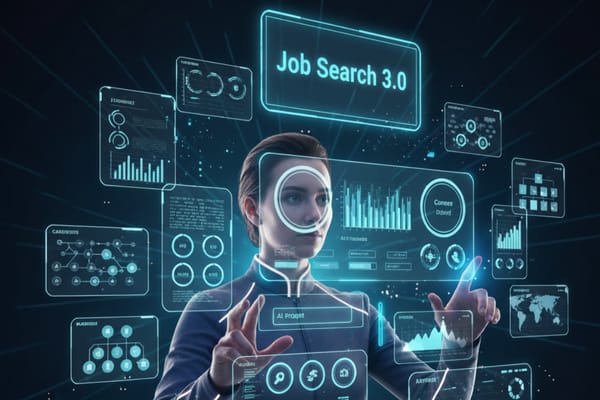
Layoffs end employment. They don’t end reputation.
Most laid-off employees are sent back into a job market that no longer works the way they were taught. Job Search 3.0 is an 11-module, AI-powered program companies use to help exiting employees attract opportunities that never hit job boards. It teaches modern visibility, recruiter discovery, and job-search strategy—without false promises or generic advice.
For employers, it’s a practical, scalable way to support transitions and protect employer brand when it matters most.
…
If AI takes all the jobs away, who is going to buy their stuff?

The problem isn’t that you’re losing your job.
The problem is that the economy doesn’t know what to do with you afterward.
That’s the part no résumé advice, no LinkedIn influencer, no corporate town hall wants to touch.
Because for most of your life, the deal was simple—even if it wasn’t fair.
You work.
You get paid.
You spend the money.
The system keeps moving.
That loop is older than any of us.
And right now, it’s under stress.
Not because you failed.
Not because you didn’t “upskill fast enough.”
But because the system quietly discovered something unsettling:
It can produce value without you.
And it hasn’t figured out the consequences yet.
If you’re a jobseeker, here’s what you’re probably feeling—but struggling to name.
You’re doing everything “right.”
You’re applying.
You’re networking.
You’re learning new tools.
And still… the doors feel heavier.
The responses feel colder.
The timelines feel longer.
It feels like the economy is shrugging.
That’s not apathy.
That’s a system trying to reduce its dependency on labor—without admitting it.
Here’s the part that should actually reassure you.
If AI truly replaces massive amounts of human work, the current economic model breaks.
Not morally.
Mechanically.
Because companies don’t survive on efficiency alone.
They survive on customers with money.
And if people don’t have income…
they don’t buy phones.
They don’t buy cars.
They don’t subscribe.
They don’t upgrade.
So this idea that AI “just replaces jobs” and everything else stays the same?
Impossible.
Something has to change.
The question is what—and who pays the price during the transition.
Let’s walk through the futures everyone’s quietly debating.
First future: income gets decoupled from work.
You stop having to “earn” the right to survive.
Money shows up—not as charity—but as infrastructure.
You receive it because the economy needs you liquid, not because you clocked in.
That’s Universal Basic Income, or something like it.
Not utopian.
Not perfect.
Just an admission that when labor stops being required, wages can’t be the only on-ramp to consumption.
And here’s the controversial part:
Corporations don’t hate this idea in the long run.
Because a customer with guaranteed income is better than an unemployed former employee with nothing to spend.
Second future: radical abundance.
AI and robotics crush production costs.
Things that feel impossibly expensive today become almost trivial.
Food gets cheap.
Energy gets cheaper.
Information is nearly free.
In this world, you don’t need a huge salary—because life itself costs less.
Sounds incredible.
But here’s the catch jobseekers feel before economists do:
Abundance arrives unevenly.
Digital things get cheap fast.
Physical necessities lag.
And no one feels “post-scarcity” when rent, healthcare, and childcare still hurt.
Third future: the human economy.
This is the one people talk about with a hopeful smile.
AI does the work.
Humans do the meaning.
We stop paying for stuff—and start paying for connection.
Craft.
Taste.
Presence.
Status.
Story.
And yes—some people will thrive here.
But here’s the uncomfortable truth:
Not everyone gets to monetize their humanity equally.
Some people sell “authenticity.”
Others are told theirs isn’t marketable.
That’s not a failure of effort.
It’s a new hierarchy forming in real time.
Fourth future: the one nobody likes to name.
Nothing changes fast enough.
We don’t redistribute income.
Costs don’t drop meaningfully.
Ownership stays concentrated.
So the economy splits.
A small group trades with itself.
Everyone else survives on whatever systems remain.
Technically efficient.
Socially unstable.
History doesn’t love this outcome.
Now here’s the part that matters most to you.
These futures don’t compete.
They stack.
You can have UBI and inequality.
Abundance and exclusion.
Human creativity and economic irrelevance.
Which means the real question isn’t:
“Will AI take my job?”
It’s this:
How does purchasing power flow when work stops being the main gatekeeper?
If you’re a jobseeker, this reframes everything.
Your anxiety isn’t about skill alone.
It’s about relevance.
Not “Can I do the work?”
But “Does the system still need me to participate?”
That’s why the fear feels existential.
And that’s also why the solution isn’t just another certification.
It’s positioning yourself where:
trust still matters,
judgment still matters,
context still matters,
responsibility still matters.
Not because AI can’t do anything—but because organizations still need someone accountable when it does.
And HR leaders—this part is for you.
You are standing at the fault line.
You’re being asked to optimize for efficiency while preserving legitimacy.
To automate while maintaining trust.
To reduce headcount while claiming people are still the priority.
The tension you feel isn’t hypocrisy.
It’s history pressing forward.
Your role is quietly shifting from talent acquisition to economic mediation—deciding who stays connected to opportunity and who drifts out of the system.
That’s heavier than any req load.
Let me end where this all comes together.
There’s an old story about a factory filled with robots.
A joke is made about union dues.
And the reply cuts deeper than intended:
Who’s going to buy the cars?
That question still hasn’t been answered.
And until it is, no amount of AI progress is stable.
Because an economy that can make everything—but can’t distribute purchasing power—isn’t the future.
It’s a stall.
So if you’re feeling unsettled, uncertain, even angry—
Good.
That means you’re paying attention.
The rules are changing.
The math is changing.
And relevance is being renegotiated in real time.
You’re not behind.
You’re early.
And what happens next depends less on technology…
and more on whether we remember one simple truth:
No system survives without people who can afford to participate in it.
…
The Comics Section

…
One more thing before I go…
Have you registered for the ProvenBase Live Webinar on February 19 at 1 PM EST?

Bring your toughest hard-to-fill roles and email them to [email protected]. Watch ProvenBase Deep Search solve them live—just for you and your team.
Hear from sourcing expert Jim Stroud, and Global Talent Leader - Shally Steckerl. 🎯 Save your seat today: https://lnkd.in/e67BbNSX
…
And as always, hit reply and let me know how I’m doing. Or slide into my DMs as the kids say. All good.
…

Reply