- The Recruiting Life
- Posts
- What else can a recruiter do?
What else can a recruiter do?
Your next job may be fixing the thing that replaced you.

Jim Stroud
September 13, 2026

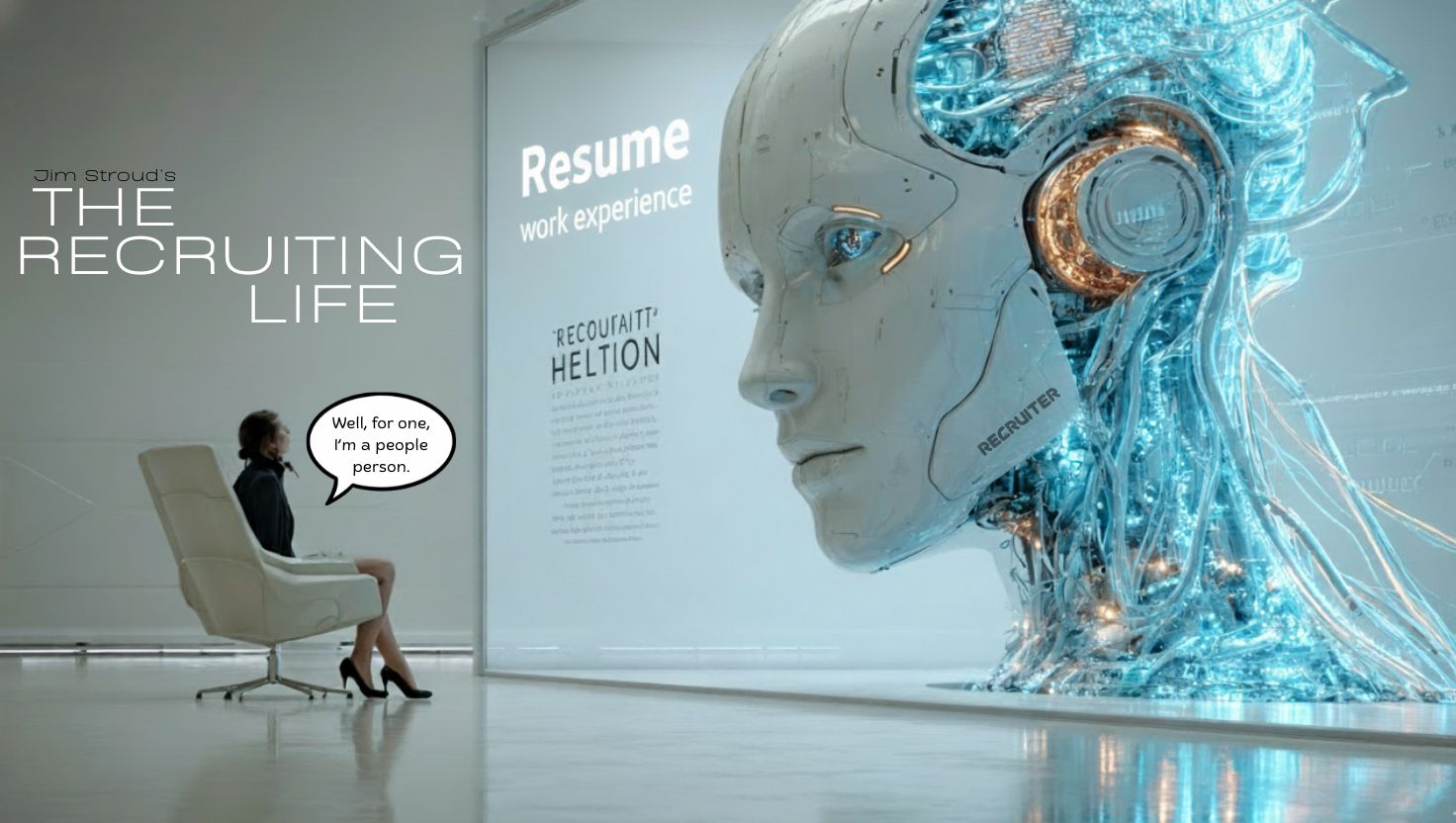
The Recruiting Life Newsletter
the skinny
AI made everyone faster and nobody richer. That gap is a job.
You already redesign broken workflows. Nobody paid you for the title.
Anyone can wire an agent. Few can prove it worked.
Read. 👇
Sponsored by ProvenBase
Your AI sourcing stack made you faster at fishing the same pond.
Speed on a broken workflow is a quicker trip to the bottom.
Everyone runs the same searches.
Everyone surfaces the same forty people.
Everyone bids.
The candidate who accepts a discount in a crowded market didn't lower his value. He postponed the bill. When the market turns, he leaves, and you pay for that hire twice.
ProvenBase changes the input, not the pace.
Hidden talent isn't cheaper.
It just hasn't been bid up.
Fewer competing offers.
Better fit.
Hires that stay.
👉 Change the input and stop hiring future turnover.
What else can a recruiter do?

The badge stopped working on a Tuesday. Severance cleared, the job boards remembered your name, and now you are sixty applications deep into a machine you used to operate. You know what happens to those files. You built that funnel. Now you live inside it.
Meanwhile, the company that cut you is stuck on a problem nobody in the building can name.
They bought the artificial intelligence (AI). Licenses for everybody. A pilot in customer service, a second one in finance, a deck with the word "agentic" splashed across slide four. Eighteen months later the work takes just as long as it always did.
The numbers say so out loud. Census Bureau researchers covering November 2025 through January 2026 found 18% of firms using AI in a business function, rising to 32% weighted by employment. Among firms that adopted, 66% use AI to augment tasks and nothing more. McKinsey surveyed 1,719 leaders and found 80% reporting better personal productivity. Movement in earnings before interest and taxes (EBIT)? That share sat at 37%, flat against the prior year. St. Louis Fed economists clocked weekly generative AI users saving 5.4% of their work hours, then cautioned those gains may never surface in productivity statistics.
That is the gap. Hours won at the desk that never land on the ledger.
Somebody has to close it. That somebody walks into a bleeding process, maps where it leaks time and quality, then decides which steps stay human, which belong to plain software, and which an agent can run on a short leash. Then they test it. Then they get people to use it. Then they prove what changed.
The job has a name problem
"AI Process Orchestrator" sounds great and returns nothing on a job board. The titles that get funded look duller. AI Workflow Analyst. Business Process Improvement Lead. AI Product and Operations Manager. Automation and Agentic Workflow Consultant. Inside human resources (HR), it wears a badge that reads Talent Acquisition Operations or HR Technology Implementation.
Pick the boring title. Boring titles have budget codes.
Why a recruiter has an unfair head start
You already run an operating system held together with tape. Intake. Calibration. Sourcing. Pipeline. Scheduling. Compliance. A hiring manager who rewrites the spec in week five and swears he never changed it.
Every day you diagnose bottlenecks, negotiate who decides what, and drag eight people toward one call. That is workflow design. The industry just never paid you for the name.
The market is shoving you there anyway. Gem's 2025 benchmarks, drawn from four years of applicant tracking data, show the average recruiting team shrinking from 31 people in 2022 to 24 in 2024. Each recruiter carried 14 requisitions and north of 2,500 applications. July logged 7.3 million openings against 5.1 million hires, and professional and business services shed 188,000 hires in a single month.
The machine is already in your lane. Recruiting is the single most common use of AI inside HR at 27% of organizations, ahead of HR technology and learning. Fewer than half of all organizations were expected to use AI in HR at all this year.
Shallow adoption in your own function. That is not a threat. That is a job description waiting for somebody to claim it.
Deploying an agent is the cheap part
Anybody can wire up an agent now. The tutorials are free and the skill goes stale in a quarter. Value sits in the five things wrapped around it.
A baseline. What the workflow costs today, how long it takes, and where it fails.
A leash. What requires human approval, what data stays off limits, who owns exceptions, and when the agent stops cold.
A systems map. Which database holds truth, what permissions you need, and what the thing does when the data is garbage.
An adoption plan. What changes for the person doing the work and the manager watching her do it.
A cost model. Whether it still wins after model bills, human review, and the monitoring nobody budgeted.
Agent builders get commoditized. The operator who can prove a governed workflow got better keeps eating.
The hustle, starting Monday
One workflow. That is the whole opening move.
Days 1 to 30. Find a frequent, painful, reversible process with a real owner. Requisition quality review. Interview scheduling. Candidate status updates. Recruiting operations reporting. Baseline it cold. Volume. Cycle time. Failure modes. Systems touched.
Days 31 to 60. Build the future state with the human boundaries drawn in ink. Decision rights matrix. Requirements. Test cases. A rollback plan. Training for the people who have to live in it.
Days 61 to 90. Run a small pilot under approval and score it. Business result. Quality. Control. Adoption. Unit cost. Then write the case study.
That case study is the product. Price the diagnostic as a fixed fee. A 40 to 120 hour engagement at $150 an hour equivalent lands between $6,000 and $18,000. Treat that as a planning model rather than a going rate, because nobody publishes a rate card for work this new. Sell a defined engagement that ends in a stop or go decision. Vague capacity gets haggled to nothing.
Prefer a paycheck? Look at the anchors. The Bureau of Labor Statistics put the May 2025 median at $101,860 for management analysts and $102,320 for project management specialists. Robert Half's 2026 guide runs IT project managers from $103,500 to $147,000. No survey tracks pay for a title this new. Position against the adjacent roles and you are looking at six figures.
Two ways to blow it
Automate a decision that ends somebody's shot at a paycheck and you own the fallout. Picture the shapes it takes. An agent auto-rejects anyone under a resume score. An agent ranks the pile and buries the bottom half before a human opens the file. Regulators already treat those as employment decisions. New York City bars an automated employment decision tool unless an independent bias audit ran within the prior year, with a public summary and notice to candidates. In Mobley v. Workday, a federal court in the Northern District of California cleared a nationwide collective action over AI screening under the Age Discrimination in Employment Act. When it breaks, the company points at the workflow. Your name sits on the workflow.
So no agent rejects candidates. No agent makes the final call. A person signs, and the log proves who signed.
Then there is the martyr trap. You are not the security team. You are not counsel. You are not production support at 2 a.m. Scope the work, price it, and hand the rest to people who carry that insurance.
Six months from now
You are in a conference room with a one page before and after. Cycle time cut from nine days to three. Every exception logged. A hiring manager who quit complaining long enough to sign off.
The executive across the table skims it once.
Then he asks if you can do the same thing in finance.
The HR Blotter
The Middle Class Is Working Two Jobs and Calling It Freedom - College grads now make up more than half of America's multiple jobholders, up from roughly 35% in the 1990s. Middle earners have passed low earners in the second-job race and women are driving much of it, which tells you this is not ambition. Nobody stacks a second shift because the first one feels safe.
The Workers Are Not Coming Back Because They Were Never Born - Indeed's chief economist stood in front of a room of talent leaders in Phoenix and told them AI is the smaller problem. The civilian labor force shrank from 171.5 million to 169.7 million between December and August, and by 2030 this country is projected to bury more people than it delivers. Her fix is simple and almost nobody will do it: stop hiring the title, start hiring the hands that can do the work.
The Factory Jobs Are Not Coming Back to Anyone, Anywhere - Adair Turner came back from the numbers with bad news for every politician still selling a factory revival. China's share of global manufacturing value climbed from 6% in 2000 to 30% in 2020, and the UN's industrial agency projects 45% by 2030, built on robots and scale instead of cheap hands. The young workers aging into the labor force across India and Africa were promised a factory floor that is already automated and already spoken for.
The AI Company Modeled Your Future and Graded Its Own Homework - Anthropic published three scenarios for the American economy in 2030, and the ugly one puts knowledge-work unemployment near 18% while output runs a third above baseline. That extreme case is exactly where the company's own CEO parked his predictions last year, which means the model files its boss under alarmist. The scenario nobody charted is the one a departing researcher was shouting about on his way out the door.
The Information Economy Is Shedding Humans - The information sector dropped 23,000 jobs in August and now sits about 12% below its 2022 peak, roughly 370,000 gone in four years. Movie and sound recording work accounts for a third of the bleed, with telecom and publishing doing what they have done for two decades. More information at your fingertips than ever, and fewer people paid to make it.
…
The Jim Stroud Podcast
Not subscribed to The Jim Stroud Podcast? Then you’ve been flying blind. Here’s a sneak peek at the latest episode debuting tomorrow.
AI can help almost anyone produce average work. So how do recruiters identify the people who can actually think, judge, and create beyond the machine? Tune in and find out.
…
The Comics Section

…
One more thing before I go…
Who else besides me is going to RecFest next week? If you are, be sure to check out my panel discussion and hang out with me at Booth #77.

Okay, two things.
The Career Intelligence Weekly tracks the invisible job market for smarter career decisions. Check out the latest issue and get ahead of the labor market.

…

Reply