- The Recruiting Life
- Posts
- Hiring in the Age of Atrophy
Hiring in the Age of Atrophy
Part 2 of 2: How to find, hire, and keep people who can still think

Jim Stroud
August 30, 2026

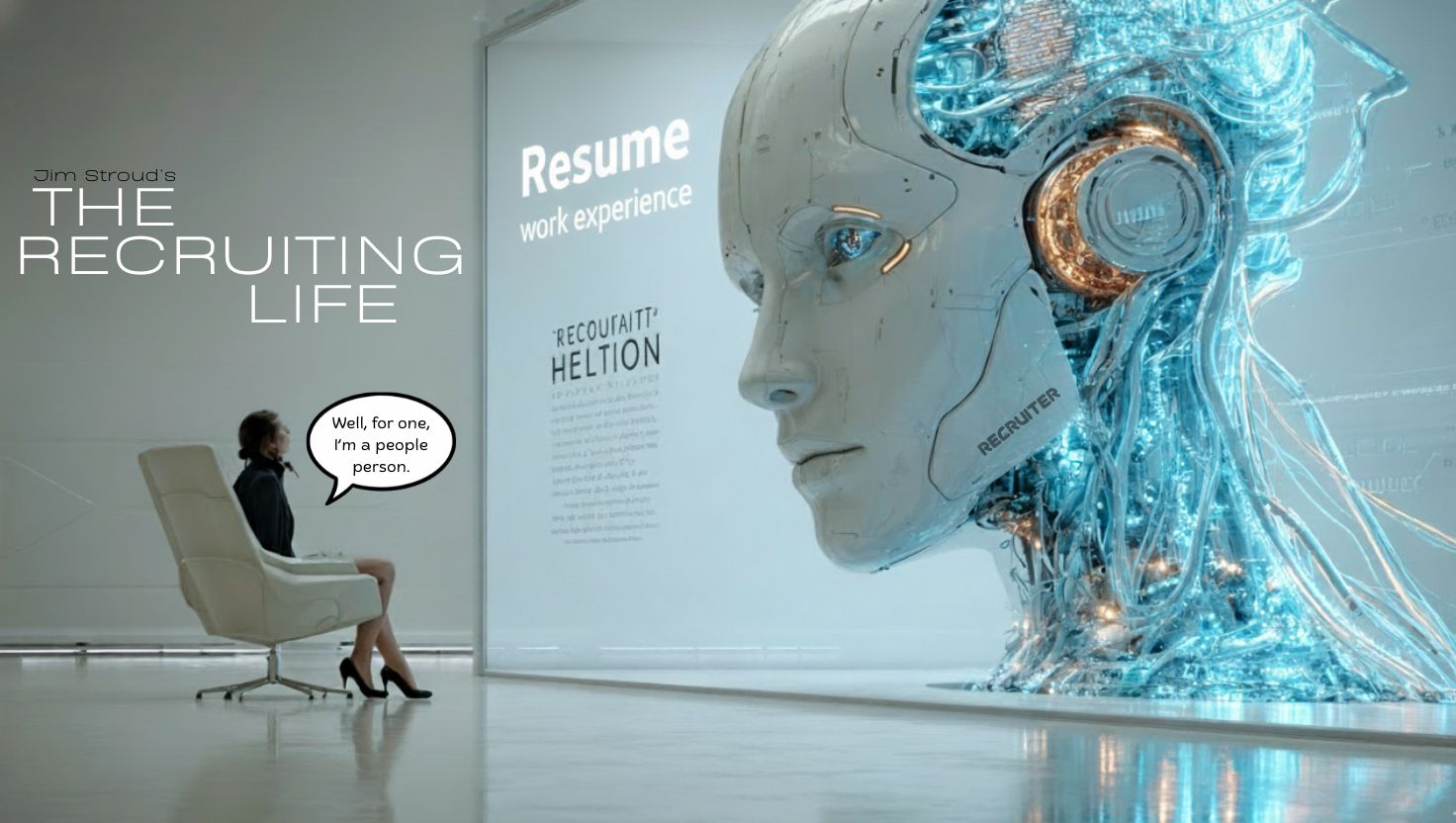
The Recruiting Life Newsletter
the skinny
In part 1, AI split the workforce into thinkers and prompt-pushers. Part 2 shows how to hire the first kind, protect the ones you already have, and catch the warning signs before your team stops thinking. Tune in and take notes. The one thing that will separate winners from everyone else is waiting at the end.
Read. 👇
Sponsored by ProvenBase
Your candidates all sound brilliant. So does the chatbot they rehearsed with.
The résumé tells you where someone sat. It no longer tells you what they can do.
ProvenBase finds the thinkers others filter out: the career switchers, the self-taught, the minds nobody handed shortcuts.
Every company gets the same tools. Only some get the people who can doubt them.
Hiring in the Age of Atrophy

The take-home assignment is dead. Artificial intelligence (AI) killed it in broad daylight, and the candidates barely bothered to hide the body.
Last week we walked through the wreckage: brain scans showing AI-first workers with dimming neural circuits, a wage premium of 28 to 56 percent for people who kept their reasoning intact, and a workforce splitting into thinkers and prompt-pushers. If you missed Part 1, go read it. This is the part where we do something about it.
The interview gets a pulse again
Smart companies are dragging assessment back into the room. Live problem-solving. Whiteboard sessions where the candidate structures a messy problem in real time, adapts when you move the goalposts, and explains their reasoning out loud with no machine whispering in their ear. Gartner predicts that critical-thinking atrophy will push half of global organizations to require "AI-free" skills assessments through 2026.
Same firm, same forecast, other side of the coin: by 2027, three out of four hiring processes will test for AI proficiency during recruiting. Put those together and you get the emerging standard, the dual assessment. Test them with AI. Test them without it. You need both answers, because the job requires both muscles.
Then dig. Layered follow-up questions crack rehearsed answers like dry earth. A candidate who prepped with a chatbot sounds great for two questions. Ask a third. Ask what they'd do if the data contradicted their conclusion. Ask what they got wrong the first time. Depth reveals itself under pressure. So does its absence.
One more shift: "senior" means something new now. The machine cranks out first drafts by the pound, so the bottleneck moved from production to review. Senior is the person who catches the error before it ships, spots the bias in the output, and owns the project end to end. Hire for the catch, because the draft is free.
Burn the pedigree filter 🔥
Elite universities and prestige internships used to be shortcuts for quality. Those shortcuts now lead off a cliff. A candidate from a bootcamp, a self-directed learning path, or a career switch may have built stronger independent reasoning for the plainest reason on earth. Nobody handed them shortcuts during the years that shape a mind.
Assess demonstrated capability. Portfolios you can interrogate. Live exercises. Structured interviews. Credentials tell you where someone sat. They no longer tell you what someone can do.
Keeping the brains you already have
Hiring thinkers solves half the problem. The other half walks through your door every morning and opens a chat window before coffee. Four moves protect them.
Effort before automation. The MIT data from Part 1 showed brains catching fire when people thought first and prompted second. Build that sequence into the workflow. Call it the cognitive handshake: a voice memo, a rough outline, a stated hypothesis before anyone touches the machine. Thirty seconds of independent thought changes what the brain does with everything that follows.
AI-off zones. Mark the territory where the machine stays outside. Ethical calls. Original strategy. Final quality review on high-stakes work. Some decisions deserve a human mind running at full voltage, alone.
Protect the grunt work. The routine tasks getting automated out of entry-level jobs were never just tasks. They were the gym. Gathering data, drafting reports, and building arguments is how junior people become senior people. Automate all of it and you've canceled the apprenticeship while raising the bar. Let AI feed the data. Make the human do the thinking.
Grade the reasoning, spike the test. Polished output proves nothing anymore, so evaluate judgment instead. Make people defend their recommendations out loud. Show their work. And every so often, slip a flawed AI output into the review pile and watch who catches it. Reward the catchers in public, even when their skepticism slows the line. Especially then.
Watch for the warning signs, too. Unassisted work getting worse. People who can't explain their own decisions. Output across teams converging into the same beige paste. Boston Consulting Group calls the pattern distributed de-skilling, and half the executives they surveyed already see it happening in their own shops. Each sign is smoke, and you know what smoke means.
The stakes
Every company on the planet is about to have the same models, the same tools, the same subscriptions. Cognitive horsepower from the machine becomes a commodity, like electricity. Commodities buy you entry, never advantage.
The advantage goes to the shop whose people can direct the machine, doubt the machine, and out-think the machine when it matters. Companies building that workforce now will employ people who catch million-dollar errors and generate ideas no model saw coming. The rest will run on autopilot, staffed by people who freeze when the screen goes dark.
The habits forming in this quarter's onboarding class will define your company for twenty years. Treat this as a future problem and you'll learn, too late, that it was always a present one.
The machines are cheap. Bet on the minds.
The HR Blotter
Amazon Pulls the Plug on the Humans It Sold as Software - Amazon will shut down Mechanical Turk on September 30, ending 21 years of paying strangers a few cents apiece to label photos, transcribe audio and fill out surveys. Bezos once called it "artificial artificial intelligence," and at its peak more than 500,000 turkers worked the queue before Amazon let the platform rust and Scale AI, Mercor and Prolific walked off with the customers. Every photo a turker tagged for a nickel taught the machine that just took the chair.
Teen Summer Jobs Crawl Back From the Dead, Barely - Only 35.5% of American teens ages 16 to 19 held a paying job this summer, up from 33.8% last year and a long fall from the 58% who punched a clock in 1978. Roughly 6.2 million kids worked the fryers and registers across June and July, about 19,500 more than last year, in a season forecasters had called the worst on record for teen hiring. The rest sat in summer school, logged volunteer hours for college applications, or took unpaid internships the government doesn't even count as work.
The Job Interview Now Runs on Robot Time - Tim Millard tidied his Atlanta living room at 9:30 at night and recorded interview answers for a camera because no human was coming. Ribbon says 24% of its AI interviews land between 10 pm and 2 am (35% for factory clients), and Greenhouse puts 15 to 20% of its voice-agent screens after dark, all of it pitched as a gift to parents and line cooks who can't step off the floor at noon. Millard's review of the experience: you can scream all you want, and the void doesn't answer.
The Boss Admits AI Did Nothing, Then Fires You for It Anyway - More than 90% of executives surveyed by the National Bureau of Economic Research said AI had no effect on their headcount over three years, and 89% said it moved labor productivity not one inch. The pink slips keep coming with "AI" stamped on them, and University of Pittsburgh professor Mark Ma found the stock market shrugs at those announcements while the survivors sour on the tools the company just bet the budget on. Ma's Glassdoor data shows worker sentiment toward AI predicts productivity better than anything a manager believes, which means every layoff blamed on the machine quietly sabotages the machine.
It Was Too Easy to Apply, and Now Nobody Can Get Hired - Andrew Stockwell used to post a role at Vendr and sift through 100 résumés on a good week, until the pile swelled past 1,000 and his high-paid recruiters spent their days shoveling fakes and AI boilerplate. Openings have sunk from 12.3 million in 2022 to about 7 million while one-click buttons and auto-apply bots push submissions per applicant up 46% on LinkedIn, so the same recruiters who begged for a frictionless process are now asking Greenhouse to make it hurt. Stockwell left in February, works the job hunt like a shift, and says an online application gets him a phone call less than 2% of the time.
…
The Jim Stroud Podcast
Not subscribed to The Jim Stroud Podcast? Then you’ve been flying blind. Here’s a sneak peek at the latest episode debuting tomorrow.
…
The Comics Section

…

…

Reply