- The Recruiting Life
- Posts
- AI Is Eating the Bottom Rung of the Career Ladder
AI Is Eating the Bottom Rung of the Career Ladder
AI may not eliminate the jobs at the top, but it could erase the early-career work people need to reach them.

Jim Stroud
September 20, 2026

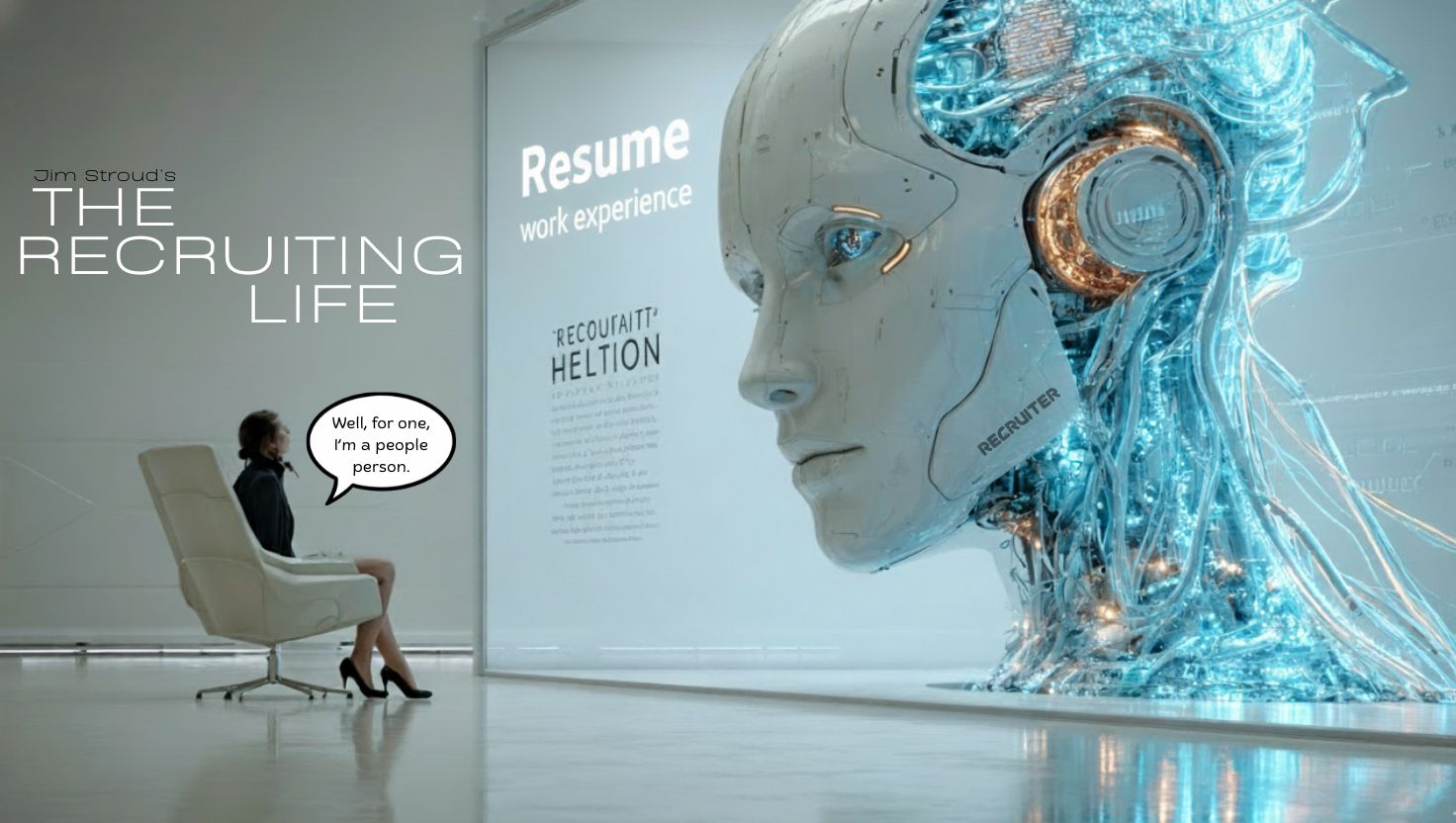
The Recruiting Life Newsletter
the skinny
AI may eliminate the entry-level work people use to build experience, leaving senior roles intact but weakening the pipeline that produces future experts.
Read. 👇
Sponsored by ProvenBase
AI can automate the work. It can’t manufacture the experience.
If entry-level work disappears, where does future expertise come from?
That makes experienced talent even harder to find.
ProvenBase helps you find qualified people traditional searches miss.
Less crowded pools.
More relevant talent.
Better visibility.
AI Is Eating the Bottom Rung of the Career Ladder
For decades, companies had a fairly predictable way of creating experienced workers. They hired inexperienced ones.
A new graduate joined the company and did the grunt work. The junior analyst built spreadsheets. The new recruiter screened resumes and hunted for candidates. The young programmer fixed simple bugs. The entry-level cybersecurity analyst reviewed alerts. They researched, summarized, documented, scheduled and performed dozens of tasks senior employees had long since graduated from doing.
The work was not glamorous, but that was partly the point. Those tasks were how people learned. You did the simple work until you understood enough to handle the complicated work. You made mistakes where the consequences were relatively small. Someone more experienced corrected you. Eventually, after seeing enough variations of the same problem, you began recognizing patterns.
We called that experience.
Artificial intelligence is disrupting that arrangement because AI is becoming very good at the work we traditionally gave beginners. That leaves companies with an uncomfortable question: Why hire someone inexperienced to do work AI can already do?
The answer could reshape the workforce for years.
The Entry-Level Squeeze Is Starting to Show Up in the Data
Researchers at the Stanford Digital Economy Lab have been tracking employment using high-frequency payroll data covering millions of U.S. workers. Their latest findings deserve the attention of every CHRO, talent acquisition leader and job seeker.
Among workers ages 22 to 25 in occupations highly exposed to AI, employment now stands about 19% below where it would be if it had kept pace with young workers in less AI-exposed occupations. Experienced workers in those same AI-exposed occupations show no comparable gap.
Even more interesting is how this appears to be happening. Companies are not primarily firing armies of young employees and replacing them with ChatGPT. The Stanford researchers found that the adjustment is showing up mainly through reduced hiring of young workers rather than increased separations.
The researchers are appropriately careful about the conclusion. They describe the findings as early, descriptive indicators rather than proof that generative AI caused the entire decline. But the pattern has strengthened as AI adoption has expanded.
That distinction matters because the AI jobs story may not begin with a pink slip. It may begin with an offer letter that never gets written.
AI Is Very Good at Beginner Work
Think about how expertise develops. A junior employee receives a relatively straightforward problem. They research it, attempt to solve it and occasionally screw it up. Someone corrects them. They try again. Eventually, they encounter enough variations of the problem that they begin recognizing what matters, what does not and what tends to go wrong.
Years later, we call that person experienced.
AI creates a strange problem in that system because much of the work easiest to automate is also the work traditionally assigned to beginners. The junior marketer drafts basic copy. The junior developer writes routine code. The junior analyst summarizes information. The junior recruiter screens candidates. The junior cybersecurity employee reviews routine alerts.
These are exactly the kinds of structured, repeatable and information-heavy activities generative AI handles increasingly well.
That is already affecting hiring decisions. A recent Gartner survey of CHROs found that 22% said at least one business leader in their organization had stopped hiring for some entry-level positions because of AI automation. Gartner also found that 95% of organizations had implemented AI in some capacity, although only one in five reported significant or transformational value from it.
There is a brutal irony hiding inside those numbers. Companies still need experienced people. They just may need fewer inexperienced people on the way to becoming experienced.
Judgment Is Becoming More Valuable
The labor market appears to be separating work into two broad categories.
There is work AI can perform because the knowledge is documented, repeatable and relatively easy to codify. Then there is work requiring context, judgment, relationships and the scar tissue that comes from having seen something go wrong before.
The Stanford research found declines concentrated in occupations where AI primarily substitutes for human tasks. Where AI appears to complement workers instead, employment has been flat or rising, particularly among experienced workers.
PwC's 2026 Global AI Jobs Barometer points in a similar direction. Its analysis suggests that AI is increasing the value of distinctly human capabilities in many AI-exposed occupations. As machines handle more routine execution, employers can place greater value on judgment, leadership, collaboration and the ability to operate in ambiguity.
That creates a peculiar labor-market equation. AI can make an experienced employee dramatically more productive while simultaneously reducing the amount of junior labor required underneath that employee.
The machine does the first pass. The experienced worker decides whether something smells wrong.
The problem is that the second skill takes years to build.
HR Has a Succession Problem Hiding Inside an Automation Strategy
Imagine a company eliminates half of its entry-level hiring because AI handles the work those employees previously performed.
For the next two years, the numbers might look fantastic. Productivity rises. Labor costs fall. Revenue per employee improves. Executives congratulate themselves for embracing AI.
Then five years pass.
The company needs senior analysts, experienced recruiters, engineering managers, cybersecurity leaders and people capable of making difficult decisions when the AI does not know what to do.
Where did those people come from?
You cannot recruit ten years of experience from someone who was never given year one.
This is why HR leaders should pay close attention to companies taking a different approach. IBM, for example, is redesigning entry-level work around AI rather than assuming the arrival of AI eliminates the need for junior employees. The idea is that early-career workers can move sooner toward analysis, problem-solving, customer interaction and other higher-value responsibilities while AI absorbs more repetitive tasks.
Gartner makes essentially the same warning. Eliminating entry-level pipelines can eventually force employers to pay premiums for experienced people they must recruit externally because they stopped developing them internally. Organizations therefore need new ways for early-career employees to build skills, networks, business knowledge and judgment when routine work no longer provides those experiences naturally.
That may prove to be one of the most important workforce lessons of the AI era: Do not confuse automating beginner tasks with eliminating the need for beginners.
Recruiters Need to Rethink What “Entry Level” Means
For recruiters, this creates a practical problem. Companies may continue posting supposedly entry-level positions while quietly stuffing them with expectations that previously belonged to experienced workers.
If AI handles basic execution, hiring managers naturally begin asking candidates to provide the things AI cannot easily provide: judgment, communication, creativity, influence, business acumen and domain expertise.
But where exactly was a 22-year-old supposed to acquire all that?
The danger is an experience paradox on steroids. Employers want experienced judgment because AI makes routine execution cheap. At the same time, those employers reduce the opportunities through which people historically developed experienced judgment.
Something has to replace the old apprenticeship model.
Companies will need redesigned early-career programs built around simulations, shadowing, mentorship, rotations, increasingly difficult assignments and supervised AI use. Managers may need to deliberately expose junior employees to decisions they previously encountered naturally while doing grunt work.
Learning can no longer be an accidental byproduct of low-level tasks. It has to become part of the architecture of work.
Job Seekers Need a Different Strategy Too
For early-career candidates, the message is not simply “learn AI.” That advice is already becoming too generic to be useful.
The stronger strategy is to demonstrate what sits above the tool. Show how you evaluate an AI answer. Show when you rejected one. Explain the assumptions you challenged. Demonstrate how you approached an ambiguous problem where the prompt itself was not obvious.
If you used AI to complete something, be prepared to explain your contribution beyond pressing Enter. What did you know that the AI did not? What did you change? What did you verify? Where was the machine wrong? What judgment did you apply?
Build evidence of judgment before someone gives you the title that supposedly proves you have it.
And do not underestimate domain expertise. AI can retrieve information remarkably well. It does not magically give someone ten years of understanding why a hospital operates differently from a factory, why one candidate will thrive under a particular hiring manager, or why an apparently harmless decision can create a problem six months later.
The person who knows how to use AI will have an advantage. The person who understands the problem, recognizes when the AI is wrong and knows what to do next may have a career.
The Missing Rung
There is plenty of debate about whether AI will destroy jobs. That may be the wrong question.
The more immediate question is whether AI changes how people become qualified for the jobs that remain. A career ladder does not work particularly well when someone removes the bottom rung.
That means HR leaders should examine every automation initiative with two questions: What work can AI eliminate? And what did employees used to learn while doing that work?
The first question creates efficiency. The second protects the future workforce.
Ignore it, and companies may eventually discover something strange.
They successfully automated the junior employee, only to spend a fortune searching for the senior employee that junior employee was supposed to become.
The HR Blotter
Amazon Buys the Wage Floor for a Buck and Change - Amazon lifted starting pay to $20 an hour, tossed in a Whole Foods discount, and rolled out a credit union perk called Day 1 Financial. The $1.5 billion price tag works out to 0.06% of a $2.68 trillion market cap. On the fulfillment subreddit, one worker priced the 20% Whole Foods discount against the regular grocery store and the math came out flat.
Big Law Now Screens for Scrambled Eggs and Birdhouses - White-shoe firms and Wall Street banks are pushing candidates to load their résumés with strange hobbies: birdhouses, restaurant-quality scrambled eggs, hot dog eating contests, olive oil. AI flattened every résumé into the same slab of prestige, so recruiters are hunting for a pulse. A Bay Area legal recruiter said half her placements last year came in with hobbies listed, when a few years back the number was zero.
Black Unemployment Fell, and 288,000 People Left With It - Black unemployment slid from 7.3% in January to 6.0% in August, a headline that looks like a win. The Black labor force lost 288,000 people over the same eight months while employment sat still. Black men picked up construction and manufacturing work while the government paychecks Black women lean on kept getting cut.
In Victoria, the Boss Has to Prove Why You Can't Stay Home - The Australian state of Victoria is weighing a law that would give eligible workers the right to work from home two days a week. Unlike the right-to-request laws in the UK and Ireland, this one flips the script and puts the burden on the employer to explain why the worker has to sit in the office. Don't hold your breath in America, where at-will employment still lets a boss show you the door on a whim.
1,316% for the Boss, 28% for You - CEO pay at the top 350 U.S. firms jumped 14% in 2025 to an average of $27.9 million, or 325 times the typical worker's paycheck. In 1965, the ratio was 21 to 1. Since 1978, executive compensation is up 1,316% while worker pay crawled up 28%.
…
The Jim Stroud Podcast
Not subscribed to The Jim Stroud Podcast? Then you’ve been flying blind. Here’s a sneak peek at the latest episode debuting tomorrow.
…
The Comics Section

…
One more thing before I go…
I’m leading a panel at RecFest this week. If you are in Nashville, stop by and say hello.

Okay, two things.
The Career Intelligence Weekly is growing in popularity. Come see what the hubbub is all about, especially if you want to elevate your career to the next level.
…

Reply